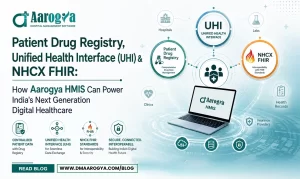
What is Patient Drug Registry, Unified Health Interface (UHI) & NHCX FHIR: How Aarogya HMIS Can Power India's Next Generation Digital Healthcare
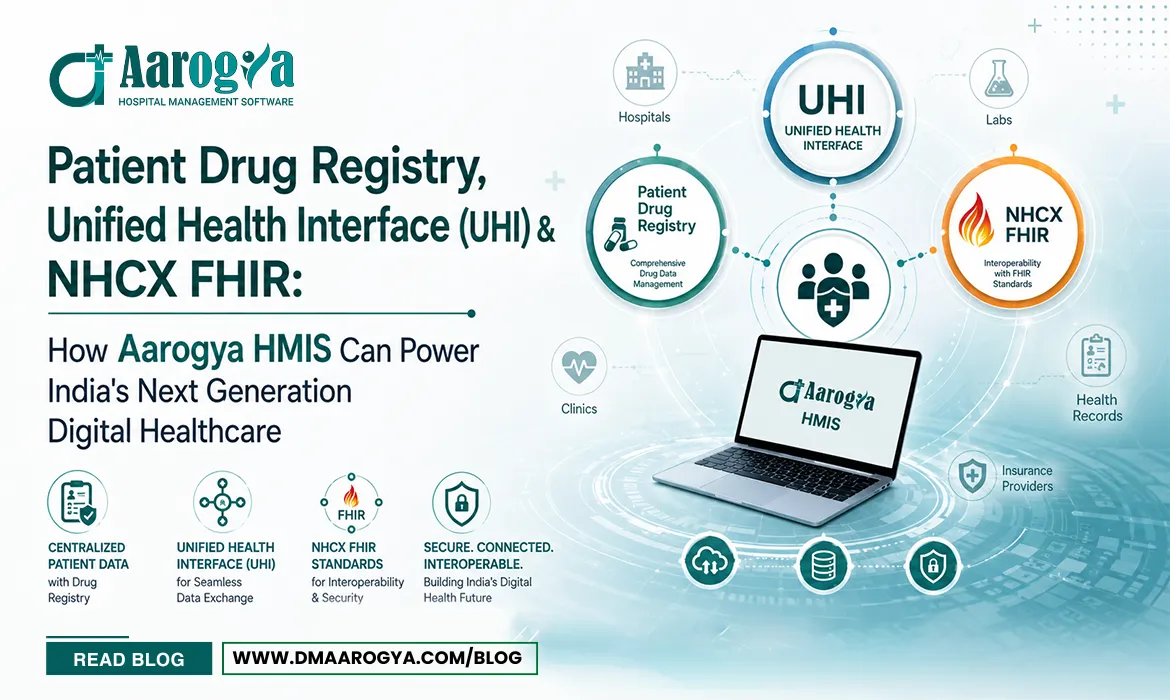
Table of Contents
ToggleIndia’s Digital Healthcare Revolution
Patient Drug Registry, Unified Health Interface (UHI), and NHCX Object Modelling are modernizing India’s digital healthcare ecosystem by allowing for secure, standardized, and interoperable health data transmission. As part of the Ayushman Bharat Digital Mission (ABDM), these efforts enable hospitals, healthcare providers, laboratories, pharmacies, insurers, and patients to connect via a single digital health network.
The Ayushman Bharat Digital Mission (ABDM)is transforming India’s healthcare system in unprecedented ways. The purpose is to build a linked healthcare ecosystem in which hospitals, doctors, laboratories, pharmacies, insurance companies, and patients can safely exchange healthcare data.
As digital healthcare use increases, hospitals want standardized data, secure interoperability, and seamless integration of various healthcare systems.
In this comprehensive guide, you’ll learn everything about the Patient Drug Registry, UHI, and NHCX FHIR Object Modelling, including their purpose, benefits, implementation guidelines, and how they are shaping digital healthcare in India.
You’ll also discover how Aarogya HMIS helps hospitals stay aligned with these government initiatives by supporting interoperability, standardized workflows, and seamless digital healthcare integration.
NOTE : Looking for the best Hospital Management Information System for your healthcare facility? Explore our city-wise guides to find the right HMIS solution for your hospital.Read Also: Best HMIS in Bangalore /Best HMIS in Kolkata Blog /Best HMIS in Kanpur

Why Did the Government Introduce These Initiatives?
Healthcare institutions frequently employ many software systems to store patient data in various formats. This causes problems when hospitals need to share medicines, insurance information, laboratory data, or medical records.
The government’s goal is to establish universal digital standards for secure information exchange among healthcare providers.
These efforts support:
- Standardized healthcare records.
- Improved patient safety
- Digital prescriptions
- Faster insurance claim processing
- Better interoperability.
- Improved patient experience.
According to the World Health Organization (WHO) Digital Health digital health technologies improve healthcare accessibility, efficiency, and quality when deployed within established frameworks.
Understanding the Patient Drug Registry
The Patient Drug Registry is a standardized national medicine database that offers verified medication information to healthcare providers and digital applications.
Today, every hospital has its own medicine master database. While this strategy works on its own, problems frequently arise because pharmaceutical names are inputted differently between hospitals.
For example, the same medication may appear as:
- PCM 650
- Paracetamol tablet
- Paracetamol (650)
- Paracetamol Tablet, 650 mg
Although these names pertain to the same medicine, inconsistencies might result in duplicate entries, reporting issues, inventory mismatches, and prescribing confusion.
The Drug Registry solves these concerns by providing a consistent reference database for hospitals to utilize when identifying medications. For readers who want to understand how medicine standardization supports healthcare interoperability, the National Health Authority (NHA) and ABDM provide detailed guidance on national digital health standards.

How Does the Patient Drug Registry Work?
The Drug Registry serves as a central repository for verified medical information.
Rather of depending entirely on local medicine databases, hospital software can access standardized medication information via secure APIs.
Example Workflow
- Doctor Opens Aarogya HMIS
↓ - Searches “Paracetamol”
↓ - Aarogya HMIS sends request to Patient Drug Registry
↓ - Registry returns standardized medicine information
↓ - Doctor selects verified medicine
↓ - Electronic prescription generated
↓ - Pharmacy dispenses medicine using the same standardized information
This strategy assures that doctors and pharmacists use the same pharmaceutical data, decreasing medication errors and boosting patient safety.
How Aarogya HMIS Can Support the Patient Drug Registry
Aarogya HMIS was created to enable current digital healthcare workflows.
Aarogya HMIS can help hospitals standardise pharmaceutical information across clinical and pharmacy departments by linking with the government’s Patient Drug Registry via secure APIs.
Potential capabilities include:
✔ Standardized medicine search
✔ Improved prescription accuracy
✔ Reduced duplicate medicine entries
✔ Better pharmacy coordination
✔ Faster medicine identification
✔ Enhanced patient safety
✔ Improved interoperability
✔ Support for ABDM-compliant workflows
Since these integrations depend on Government APIs and hospital implementation, hospitals should confirm technical readiness before enabling production use.
NOTE : Want to strengthen patient engagement along with digital healthcare? Discover how a Healthcare CRM can improve patient communication, follow-ups, and hospital efficiency.
Read Also: Healthcare CRM Software Blog
Benefits for Every Stakeholder
Stakeholder | Benefit |
Doctors | Faster medicine search and improved prescribing accuracy |
Pharmacists | Standardized medicine identification and inventory consistency |
Hospital Administrators | Better reporting and reduced duplicate medicine records |
Patients | Safer prescriptions and improved continuity of care |
Suggested Reading Throughout This Section
Readers who want to explore these concepts further can refer to:
Introducing the Unified Health Interface (UHI)
While the Patient Drug Registry focuses on standardizing medicine information, another major initiative under the Ayushman Bharat Digital Mission (ABDM) is transforming how patients discover and access healthcare services the Unified Health Interface (UHI).
Think of UHI as the healthcare equivalent of UPI. Just as UPI allows users to make payments across different banks and apps, UHI creates an open digital network where patients can discover hospitals, doctors, diagnostic centres, pharmacies, and telemedicine providers without being restricted to a single platform.
Instead of visiting multiple hospital websites or downloading separate applications, patients can use any UHI-enabled application to search for healthcare services, compare providers, book appointments, and access digital consultations.

Why Was UHI Introduced?
Healthcare accessibility has traditionally been fragmented. Patients often face challenges such as:
Searching multiple websites to find specialists.
Limited visibility of doctor availability.
Manual appointment booking.
Long waiting times.
Difficulty accessing teleconsultation services.
The Government introduced UHI to create a common digital network that connects healthcare providers and patients through standardized protocols.
According to the National Health Authority (NHA), UHI promotes an open and interoperable healthcare ecosystem where healthcare services become easier to discover and access digitally.
How Does UHI Work?
Instead of every hospital maintaining an isolated appointment system, UHI allows healthcare providers to publish their services on an open digital network.
A simplified workflow looks like this:
| Step | Activity |
|---|---|
| 1 | Patient opens any UHI-enabled healthcare application. |
| 2 | Searches for a speciality, doctor, or hospital. |
| 3 | Available healthcare providers are displayed. |
| 4 | Patient selects a preferred hospital. |
| 5 | Appointment is booked digitally. |
| 6 | Hospital receives the booking in its HMIS. |
| 7 | Patient receives confirmation and reminders. |

How Aarogya HMIS Can Support UHI
Aarogya HMIS can help hospitals by integrating with the Unified Health Interface (UHI), which allows them to engage in India’s linked healthcare ecosystem.
Hospitals that integrate UHI have the potential to :
Make doctor scheduling available digitally.
Show the available appointment slots.
Enable online appointment booking.
Support teleconsultation procedures.
Reduce the front-office workload.
Increase patient convenience.
Increase hospital visibility using UHI-enabled applications.
For patients, this means they can find hospital services more simply, arrange appointments online, and have a more seamless digital experience before even attending the hospital.
Practical Use Case
Imagine a patient named Ravi who wants to consult a cardiologist.
Instead of calling multiple hospitals, Ravi opens a UHI-enabled healthcare app and searches for “Cardiologist near me.”
The app displays hospitals that have published their services through UHI.
Ravi selects a hospital using Aarogya HMIS, views the doctor’s available slots, books an appointment, and receives a digital confirmation instantly.
When Ravi arrives at the hospital, his appointment details are already available in Aarogya HMIS, reducing registration time and improving the patient experience.
This connected workflow benefits both patients and hospital staff by reducing manual coordination and improving operational efficiency.
Benefits of UHI Integration
Stakeholder | Benefits |
Patients | Easy doctor discovery, faster appointments, improved convenience |
Doctors | Better appointment management and digital scheduling |
Hospitals | Increased visibility, reduced manual booking effort, improved patient experience |
Administrators | Streamlined operations and better utilization of healthcare resources |
Preparing Hospitals for Connected Healthcare
Digital healthcare is no longer limited to maintaining electronic medical records. Modern hospitals are expected to exchange information securely with national healthcare platforms while maintaining interoperability.
By supporting initiatives like the Patient Drug Registry and Unified Health Interface (UHI), Aarogya HMIS can help hospitals move toward a more connected and patient-centric healthcare ecosystem.
The next step in this transformation is enabling standardized health insurance claim exchange. This is where NHCX FHIR Object Modelling plays a crucial role by creating a common language for exchanging healthcare and insurance data between hospitals and payers.
NOTE : Hospitals embracing digital transformation should also understand quality and compliance standards. Learn how NABH guidelines support safer, standardized, and technology-enabled healthcare delivery.
Read Also: NABH Guidelines for Hospitals
NHCX FHIR Object Modelling: Simplifying Digital Health Insurance Claims
As hospitals become more digital, sharing patient and insurance information promptly and properly has become critical. To address this issue, the Indian government established the National Health Claims interchange (NHCX), which leverages FHIR (Fast Healthcare Interoperability Resources) to standardize healthcare data interchange.
The National Health Claims Exchange (NHCX) is a digital platform that allows hospitals, insurance companies, and third-party administrators (TPAs) to exchange health insurance claim data electronically. To ensure that all systems communicate in the same format, NHCX adheres to the HL7 FHIR Standard, an internationally recognized foundation for healthcare interoperability.
What is FHIR?
FHIR (Fast Healthcare Interoperability Resources) is an international standard produced by HL7 International . It specifies how healthcare systems should organize and share data such as patient demographics, medications, laboratory tests, diagnoses, treatments, and insurance claims.
Without a consistent standard, hospitals and insurers may employ disparate data formats, making claim processing slow and error-prone. FHIR ensures that all systems involved “speak the same language.”
For readers interested in the technical standard, the FHIR Specification gives a thorough overview of resources, APIs, and implementation guidelines.

Why is NHCX Important for Hospitals?
Traditional insurance claim handling frequently includes:
Manual data entry.
Email interactions.
Multiple document submissions
Delay in approvals
High likelihood of claim rejection owing to inadequate or contradictory information.
Hospitals can use NHCX with FHIR Object Modelling to digitally share standardized claim data, saving paperwork and boosting turnaround time.
How Aarogya HMIS Can Support NHCX
Aarogya HMIS can be designed to support NHCX-compatible workflows by generating structured patient and billing data in line with FHIR standards.
A typical workflow may include:
Step | Process |
1 | Patient is admitted in Aarogya HMIS. |
2 | Clinical and billing information is captured digitally. |
3 | Required claim data is structured using FHIR standards. |
4 | Data is shared with NHCX. |
5 | Insurance provider reviews the digital claim. |
6 | Approval or clarification is received electronically. |
7 | Hospital tracks claim status within its workflow. |
How the Three Government Initiatives Work Together
Although the Patient Drug Registry, UHI, and NHCX serve different purposes, together they create a unified digital healthcare ecosystem.
Initiative | Purpose | How Aarogya HMIS Can Support |
Standardized medicine information | Standardized medicine search and e-prescriptions | |
Digital discovery and appointment booking | Online appointments and provider availability | |
Digital health insurance claims | Standardized claim exchange using FHIR |
Together, these initiatives help hospitals:
Improve interoperability
Reduce manual effort
Enhance patient safety
Streamline insurance claims
Deliver better patient experiences
Prepare for the future of connected healthcare
Why Hospitals Should Prepare Now
Healthcare is moving toward a future where hospitals are expected to connect seamlessly with national digital health platforms. Implementing systems that support interoperability today helps hospitals stay compliant with evolving standards while improving efficiency.
By enabling support for initiatives like the Patient Drug Registry, UHI, and NHCX, Aarogya HMIS can help healthcare organizations modernize workflows, improve care coordination, and strengthen digital transformation initiatives.
Conclusion
The Patient Drug Registry, Unified Health Interface (UHI), and NHCX.are among the projects that are quickly connecting India’s healthcare ecosystem. Together, they are building the groundwork for standardized medical information, easy patient access, and efficient digital insurance claims.
Hospitals that employ interoperable technologies now will be in a better position to provide safer, faster, and more patient-centered care tomorrow.
Aarogya HMIS can assist hospitals adopt national healthcare standards while boosting operational efficiency and patient outcomes.
Ready to build a future-ready digital hospital? Explore more expert resources on HMIS, healthcare CRM, NABH compliance, patient engagement, and digital healthcare transformation in our blog library. Contact Us

FAQs
1. How does Aarogya HMIS support the Patient Drug Registry?
Aarogya HMIS is designed to support standardized medicine records by integrating with the Patient Drug Registry as per government guidelines. This helps improve prescription accuracy, medication consistency, and compliance across healthcare facilities.
2. Can Aarogya HMIS integrate with the Unified Health Interface (UHI)?
Yes. Aarogya HMIS is built to support UHI integration, enabling hospitals to connect with the ABDM ecosystem for digital appointment booking and improved patient access, subject to government APIs and implementation requirements.
3. How does Aarogya HMIS support NHCX-based health insurance claims?
Aarogya HMIS can facilitate standardized claim data exchange through NHCX, helping hospitals streamline insurance workflows, reduce manual processing, and improve claim efficiency.
4. Why is FHIR compliance important for Aarogya HMIS?
FHIR-based data exchange enables Aarogya HMIS to securely share clinical information with other healthcare systems, ensuring interoperability, faster integrations, and seamless digital healthcare services.
5. Why should hospitals choose Aarogya HMIS for ABDM and digital healthcare integration?
Aarogya HMIS offers a comprehensive digital healthcare platform with support for ABDM initiatives, including ABHA integration, interoperability standards, and scalable modules that help hospitals stay future-ready while enhancing patient care and operational efficiency.
Categories
Recent Posts
-
 28 Sep 2026What is NABH? Full Form, Accreditation, Certification & NABH-Certified HMS Explained
 -
08 Sep 2026EMR Software: What It Is, How It Works, Key Benefits, Features, and the Future of Digital Healthcare
-
16 Aug 2026What Is a Kiosk Machine? Smart Kiosks in Healthcare | Aarogya
-
27 Jul 2026Patient Drug Registry, Unified Health Interface (UHI) & NHCX FHIR: How Aarogya HMIS Can Power India's Next Generation Digital Healthcare
-
29 Jun 2026Best HMIS Software in Kolkata 2026: How Digital Healthcare Is Transforming Patient Care Across the City
-
25 Jun 2026Best Bank Reconciliation Software | Automated Bank Reconciliation with Aarogya
-
04 Jun 2026Best Hospital Management Software(HMIS) in Kanpur 2026: Complete Guide to Modern HMIS Solutions
-
26 May 2026Ophthalmology EMR Software in India 2026: Complete Guide to the Best Eye Hospital Management System
-
22 May 2026What is NABH? Full Form, Digital NABH, NHCX & HMIS Integration Explained (2026)
-
06 May 2026Best HMIS Software in Bangalore 2026: Complete Guide to Choosing the Right Hospital Management System