What is NABH? Full Form, Accreditation, Certification & NABH-Certified HMS Explained

Table of Contents
ToggleNABH stands for the National Accreditation Board for Hospitals & Healthcare Providers and is an important name associated with healthcare quality, patient safety and standardised hospital processes in India. As hospitals increasingly move towards digital healthcare, hospital management software has also become an important part of managing clinical, administrative and operational information.
Aarogya HMIS is now NABH Advance certified, marking an important milestone in its journey of providing integrated digital healthcare technology to hospitals.

For hospitals preparing for NABH accreditation, NABH-accredited hospitals looking to strengthen their digital infrastructure, and healthcare organisations evaluating a new Hospital Information System (HIS), Electronic Medical Record (EMR) or Hospital Management Information System (HMIS), choosing the right software is an important decision.
A modern hospital management system can help bring patient records, clinical workflows, billing, pharmacy, diagnostics, nursing, medical records, insurance and reporting together on one digital platform.
In this blog, we will understand NABH , NABH accreditation, NABH certification for hospital software, the role of HMIS in quality-focused hospital operations, and how Aarogya HMIS supports hospitals with a NABH-certified digital healthcare platform.
What is NABH?
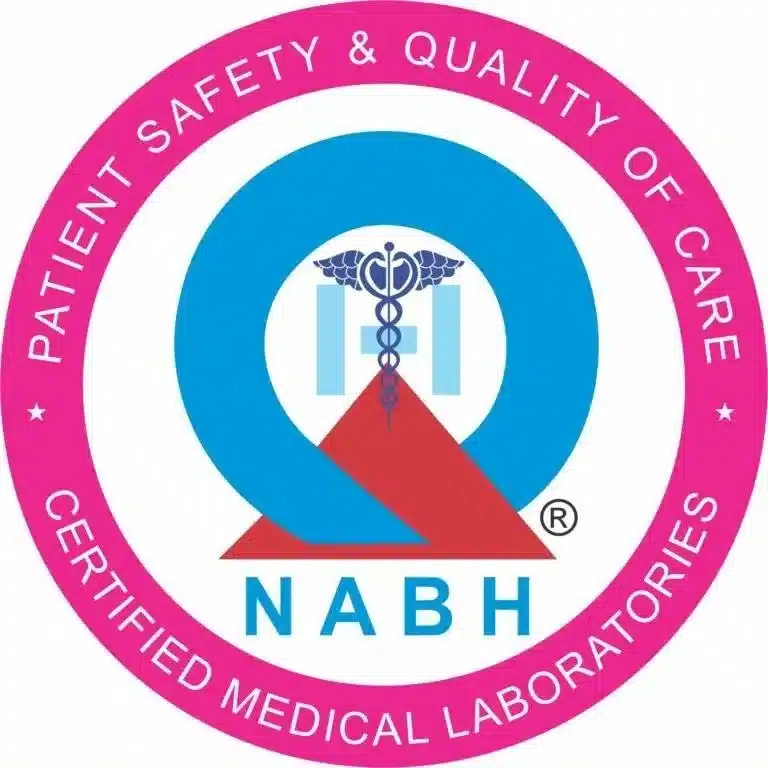
The NABH full form in healthcare is National Accreditation Board for Hospitals & Healthcare Providers.
NABH is a constituent board of the Quality Council of India (QCI) and operates accreditation and certification programmes for healthcare organisations and digital healthcare systems.
NABH standards focus on areas such as:
- Patient safety
- Quality of care
- Clinical processes
- Infection control
- Medication management
- Patient rights
- Human resources
- Facility safety
- Information management
- Quality improvement
For hospitals, NABH accreditation provides a structured framework for establishing and maintaining quality-focused healthcare processes.
As hospitals become more digital, information management has also become an important part of this ecosystem.
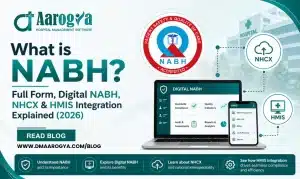
Also Read: What is NABH? Full Form, Digital NABH, NHCX & HMIS Integration Explained
What is NABH Accreditation?
NABH accreditation is a formal assessment and recognition process for healthcare organisations based on defined NABH standards.
It focuses on how hospitals establish processes for delivering safe and quality healthcare.
These processes can include:
- Patient assessment
- Clinical care
- Medication management
- Infection control
- Patient rights
- Consent
- Quality improvement
- Staff management
- Safety
- Medical records
- Information management
NABH accreditation is therefore not limited to documentation prepared for an assessment. Hospitals need structured processes that can be implemented and maintained as part of their regular operations.
This is where digital hospital management systems can play a supporting role.
An integrated HMIS can help hospitals maintain digital records, connect departments, generate reports and make relevant information available to authorised users.
NABH Accreditation vs NABH Software Certification
The terms NABH accreditation and NABH certification are often used together, but they can refer to different programmes.
NABH Accreditation
NABH accreditation applies to healthcare organisations such as hospitals.
It assesses the hospital against defined standards related to healthcare quality, patient safety and hospital processes.

NABH Certification for HIS/EMR
NABH also provides Digital Health Standards for HIS/EMR Systems.
This program is relevant to healthcare software providers and evaluates Hospital Information System and Electronic Medical Record solutions against defined digital-health standards.
In simple terms:
Hospital → NABH Accreditation
HIS/EMR Software → NABH Digital Health Certification
This distinction is important when hospitals search for terms such as:
- NABH certified software
- NABH certified HMIS
- NABH certified HIS
- NABH certified EMR
- NABH certified hospital
- management software
A hospital evaluating software should therefore look at the actual certification and its scope rather than relying only on general claims of “NABH compliant software.”
What is NABH Digital Health Certification?
NABH has introduced Digital Health Standards for HIS/EMR Systems to provide a structured framework for evaluating healthcare information systems.

These standards address important areas of digital healthcare, including:
- Clinical functionality
- Administrative functionality
- Data management
- Security
- Accuracy
- Interoperability
- Digital healthcare processes
For hospitals, this provides another factor to consider when evaluating an HIS or HMIS.
Healthcare software is no longer only about registration and billing.
A modern hospital information system may manage information across:
Registration → OPD → IPD → Nursing → Laboratory → Radiology → Pharmacy → Billing → Discharge → Follow-up
The software therefore needs to support a much wider digital healthcare ecosystem.
Why NABH-Certified Software Matters for Hospitals
Hospitals generate large amounts of clinical and administrative information every day.
Patient records, prescriptions, investigation reports, nursing documentation, billing information, pharmacy transactions and insurance records all contribute to the patient’s overall healthcare journey.
When this information is managed through disconnected systems, hospitals may face challenges such as:
- Repeated data entry
- Information silos
- Difficulty retrieving records
- Manual documentation
- Delayed reporting
- Fragmented workflows
An integrated and appropriately certified hospital information system can provide a structured digital foundation for managing these workflows.
For a hospital preparing for or maintaining NABH-focused processes, this can support better organisation of information and documentation.
Software does not itself make a hospital NABH accredited. However, the right digital infrastructure can support hospitals in implementing and managing their defined processes.
How HMIS Supports NABH-Focused Hospital Operations
A Hospital Management Information System (HMIS) connects different hospital departments and workflows through a common digital platform.
For example, consider a patient’s journey:
Registration
Patient details are captured digitally.
↓
Consultation
The doctor records clinical information, diagnosis and treatment.
↓
Investigation
Laboratory or radiology investigations are ordered and processed.
↓
Pharmacy
Prescriptions can connect with pharmacy workflows.
↓
Billing
Relevant services and transactions contribute to billing.
↓
Discharge
Discharge-related documentation and information can be maintained digitally.
↓
Follow-Up
The patient’s information remains available for future care, according to configured access and workflows.
This connected approach can reduce information gaps between departments.

Key Features to Look for in NABH-Certified HMIS
Hospitals evaluating a hospital management system should look beyond the number of modules.
1. Digital Patient Records
The system should support structured digital patient information across relevant departments.
2. Role-Based Access
Different users should have appropriate access based on their responsibilities.
3. Audit Trails
Digital audit trails can help maintain visibility into system activity and changes.
4. Clinical Documentation
Doctors, nurses and other authorised users should be able to document relevant patient-care information digitally.
5. Department Integration
Clinical, administrative and financial departments should be able to work through connected workflows.
6. Data Security
Healthcare information requires appropriate security and access controls.
7. Reporting and Analytics
Hospital information should be available through meaningful reports and dashboards.
8. Interoperability
The software should be capable of connecting with relevant healthcare systems and digital health platforms.
9. Scalability
The platform should support the hospital as it adds departments, users, locations and services.

How Aarogya HMIS Supports Hospitals
Aarogya HMIS is now NABH certified, adding another important milestone to its digital healthcare journey.
Aarogya is an integrated Hospital Management Information System designed to bring clinical, administrative and operational workflows together.
The Aarogya ecosystem covers multiple hospital functions, including:
- OPD Management
- IPD Management
- Emergency
- Nursing Station
- Pharmacy
- LIS
- RIS
- OT Management
- Blood Bank
- CSSD
- MRD
- TPA
- Inventory
- Housekeeping
- Bio-Waste Management
- Dietary
- CRM
- Accounts
- Asset Management
- MIS
This integrated approach helps hospitals manage multiple departments through a common digital platform
Aarogya HMIS for Digital Documentation
Digital documentation is an important part of modern hospital operations.
Aarogya supports structured digital workflows across different stages of the patient journey.
For example, clinical and operational information can move across connected workflows involving:
- Patient registration
- Consultation
- Diagnosis
- Laboratory
- Radiology
- Pharmacy
- Nursing
- OT
- Billing
- TPA
- Discharge
- Medical records
This reduces dependence on isolated departmental systems and provides hospitals with a more connected information environment.
Also Read: What is HMIS? Complete Guide to Hospital Management Information Systems
Aarogya HMIS, ABDM and Connected Healthcare
Why Aarogya HMIS for Compliance & Claims
Not every HMIS platform is designed to manage insurance claims and compliance requirements efficiently.
Aarogya HMIS is specifically built to meet the needs of modern hospitals, including the NHCX and NABH framework.
How Aarogya HMIS helps
- Automates insurance workflows from admission to discharge.
- Creates claim-ready billing data.
- Maintains structured digital patient records.
- Delivers audit-ready compliance reports.
- Allows role-based secure access.
- Supports ABDM-aligned digital standards.
What Makes Aarogya Different
- End-to-end hospital workflow integration
- Real-time dashboards and analytics.
- Reduced manual errors.
- Faster claim processing
- Continuous compliance monitoring
This elevates Aarogya to the status of a whole digital healthcare ecosystem, rather than merely software.
NABH is one part of India’s healthcare transformation.
The Ayushman Bharat Digital Mission (ABDM) is building a connected digital health ecosystem that enables digital health identities and health information exchange through appropriate frameworks.
Aarogya supports ABDM-related digital health workflows, while its patient-facing PHR application is positioned as an ABDM-certified application.
This gives hospitals an opportunity to connect their internal HMIS environment with the wider digital healthcare ecosystem.
How NABH-Certified HMS Supports Hospital Operations
Where applicable certification has been formally obtained, an HMS can provide a structured digital environment for hospital operations.
Depending on the system and modules implemented, hospital management software can support areas such as:
1. Digital Patient Records
Patient information can be maintained electronically, making records easier to access and manage across authorized departments.
2. Structured Clinical Workflows
Clinical and administrative processes can be organized through predefined digital workflows.
3. Medical Records Management
Electronic medical records help hospitals organize patient information and retrieve records when required.
4. Documentation
Digital systems can help maintain structured documentation across departments.
5. Audit Trails
System activity and changes can be recorded through audit mechanisms, depending on the software configuration.
6. Reporting and Monitoring
Hospitals can generate operational reports to monitor activities and support quality-management processes.
7. Department Integration
A centralized HMIS can connect different departments and reduce dependency on disconnected systems.
NABH, HMIS, HIS and EMR: Understanding the Difference
These terms are often used together but refer to different things.
HMS – Hospital Management System
An HMS manages hospital administrative and operational processes such as registration, billing, pharmacy, inventory and other workflows.
HMIS – Hospital Management Information System
An HMIS provides a broader information-management environment for hospital operations, reporting and departmental workflows.
HIS – Hospital Information System
An HIS generally refers to an integrated information system supporting clinical and administrative hospital processes.
EMR – Electronic Medical Record
An EMR focuses primarily on the digital management of a patient’s medical and clinical information.
The exact scope of HMS, HMIS and HIS can vary between healthcare organizations and software providers.
Aarogya HMIS and NHCX
Healthcare digitalisation also extends to insurance and claims.
The National Health Claims Exchange NHCX is designed to support standardized digital health-claims exchanges between stakeholders such as hospitals, insurers and TPAs.
For hospitals, insurance workflows can involve:
- Patient registration
- Admission
- Pre-authorisation
- Treatment
- Billing
- Claim documentation
- Discharge
- Settlement
Aarogya provides TPA and insurance-related workflows that connect relevant hospital information with billing and claims processes.
This is particularly useful for hospitals looking to create a more connected digital environment across clinical and financial workflows.

Why NABH-Accredited Hospitals Should Evaluate Their HMIS
Hospitals that are already NABH accredited or preparing for NABH accreditation can evaluate whether their existing digital infrastructure supports their operational requirements.
Some useful questions include:
- Can patient information be retrieved efficiently?
- Are clinical records maintained digitally?
- Are user activities appropriately controlled?
- Does the HIS/EMR have relevant NABH Digital Health certification?
- Can the platform scale with the hospital?
These questions can help hospitals assess their technology based on actual operational requirements rather than simply selecting software based on the number of features.

One Integrated Digital Healthcare Ecosystem
A modern hospital requires more than individual software applications.
It needs connected workflows.
Aarogya brings together:
Clinical Operations
OPD → IPD → Nursing → Pharmacy → Laboratory → Radiology → OT
Administrative Operations
Registration → Billing → TPA → Accounts → Inventory → MRD
Digital Health
ABDM → PHR → Digital Integrations
Management
MIS → Reports → Dashboards → Analytics
This integrated approach helps hospitals manage information across different functions within a common digital environment.
Also Read: Best HMIS Software for Hospitals
NABH and the Future of Digital Hospitals
Healthcare is becoming increasingly digital.
Hospitals are adopting:
- EMR
- HMIS
- Digital consent
- LIS
- RIS
- PACS
- ABDM integrations
- Patient applications
- Digital claims
- Analytics
- Automated reporting
At the same time, hospitals continue to focus on patient safety, quality improvement and structured processes.
NABH’s Digital Health Standards for HIS/EMR Systems reflect the growing importance of digital healthcare infrastructure.
The future hospital will therefore need both quality-focused processes and reliable digital systems.
A hospital management system can become the digital foundation connecting clinical care, administration, finance, diagnostics, pharmacy, insurance and patient engagement.
Aarogya supports ABDM-related digital healthcare workflows, and its PHR application is positioned as an ABDM-certified patient-facing application.
Conclusion
NABH represents an important framework for quality, patient safety and structured healthcare processes.
As hospitals become increasingly digital, the hospital management system supporting these processes also becomes an important consideration.
A well-integrated HMIS can help hospitals manage patient records, clinical documentation, diagnostics, pharmacy, billing, insurance, medical records and reporting through connected workflows.
For hospitals preparing for NABH accreditation and hospitals that are already NABH accredited, evaluating the quality and capabilities of their digital infrastructure can be an important part of their technology strategy.
Aarogya HMIS is now NABH Advance certified, adding another significant milestone to its healthcare technology journey.
With its integrated hospital modules, digital healthcare capabilities, ABDM-related workflows and connected hospital operations, Aarogya provides hospitals with a platform designed for modern digital healthcare.
If your hospital is looking for NABH certified hospital management software, NABH certified HMIS, HIS/EMR software or an integrated hospital management system, explore Aarogya HMIS and discover how connected digital workflows can support your hospital’s operations.
Frequently Asked Questions About NABH
1.What is NABH?
2. What is NABH accreditation?
3. What is NABH-certified hospital software?
4. Are NABH accreditation and NABH software certification the same?
5. Do NABH-accredited hospitals need NABH-certified software?
Hospital accreditation and HIS/EMR certification are separate programmes. Hospitals can consider NABH-certified HIS/EMR solutions when evaluating their digital healthcare infrastructure.
6. What is Digital NABH?
7. Is Aarogya HMIS NABH certified?
Yes. Aarogya HMIS is now NABH Advanced certified.
8. Is Aarogya HMIS ABDM certified?
Categories
Recent Posts
-
 28 Sep 2026What is NABH? Full Form, Accreditation, Certification & NABH-Certified HMS Explained
 -
08 Sep 2026EMR Software: What It Is, How It Works, Key Benefits, Features, and the Future of Digital Healthcare
-
16 Aug 2026What Is a Kiosk Machine? Smart Kiosks in Healthcare | Aarogya
-
27 Jul 2026Patient Drug Registry, Unified Health Interface (UHI) & NHCX FHIR: How Aarogya HMIS Can Power India's Next Generation Digital Healthcare
-
29 Jun 2026Best HMIS Software in Kolkata 2026: How Digital Healthcare Is Transforming Patient Care Across the City
-
25 Jun 2026Best Bank Reconciliation Software | Automated Bank Reconciliation with Aarogya
-
04 Jun 2026Best Hospital Management Software(HMIS) in Kanpur 2026: Complete Guide to Modern HMIS Solutions
-
26 May 2026Ophthalmology EMR Software in India 2026: Complete Guide to the Best Eye Hospital Management System
-
22 May 2026What is NABH? Full Form, Digital NABH, NHCX & HMIS Integration Explained (2026)
-
06 May 2026Best HMIS Software in Bangalore 2026: Complete Guide to Choosing the Right Hospital Management System