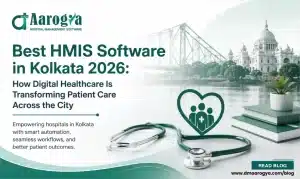
Best HMIS Software in Kolkata 2026: How Digital Healthcare Is Transforming Patient Care Across the City
Table of Contents
ToggleAre you a hospital, clinic, nursing home, or multi-specialty healthcare center in Kolkata looking for the best HMIS software available?
In a busy healthcare city like Kolkata, which is frequently regarded as the entrance to Eastern India, handling expanding patient volumes, different departments, billing systems, diagnostics, pharmacy operations, and patient records may quickly become difficult without the proper technology.
Today’s healthcare businesses require more than just software. They require a connected system that allows doctors, nurses, administrators, and finance teams to collaborate quickly while providing a consistent patient experience.
Aarogya HMIS can help in this situation. Designed to streamline hospital operations and facilitate digital healthcare transformation. Everything from patient registration and appointments to diagnostics, billing, pharmacy management, and reporting can be managed through a single platform.
As hospitals in Kolkata continue to embrace digital healthcare, selecting the correct HMIS is becoming a critical step in creating a smarter, more efficient, and patient-centric healthcare environment.
In this article, we’ll look at why healthcare businesses in Kolkata are investing in HMIS systems and how Aarogya HMIS can help with operational excellence and long-term growth.
What is HMIS software?
A Hospital Management Information System (HMIS) is a digital platform that enables healthcare companies to centrally manage clinical, administrative, operational, and financial activities.
Consider it as the hospital’s digital backbone.
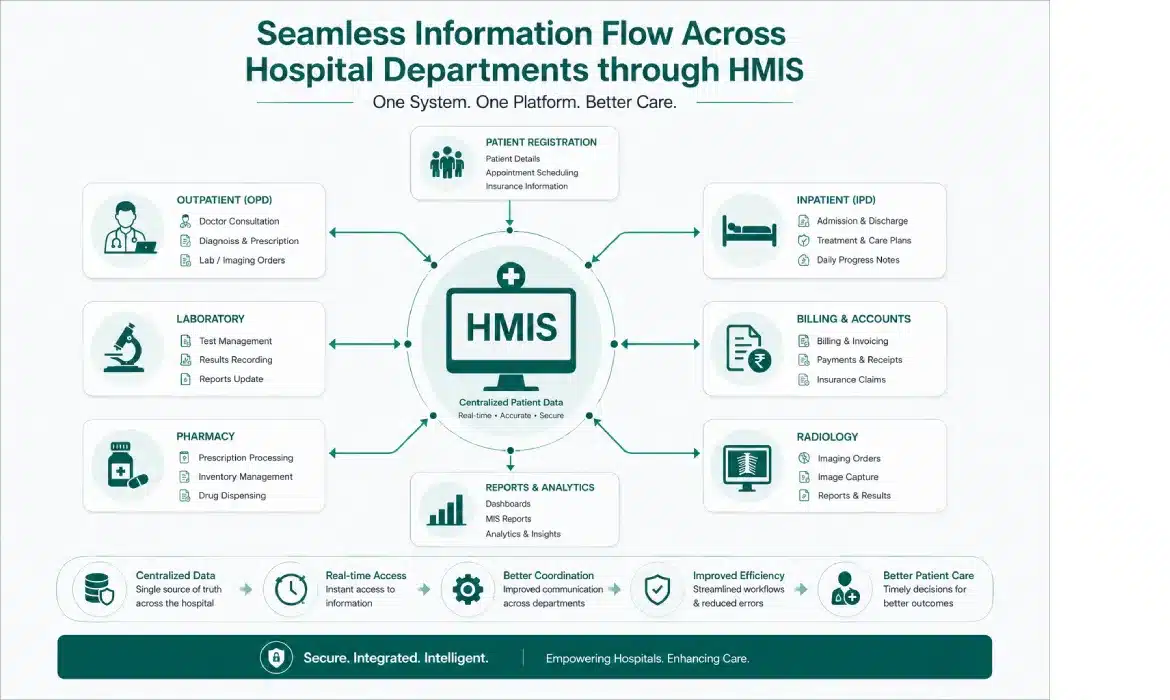
HMIS consolidates registration, appointments, billing, diagnostics, pharmaceutical administration, and patient data into a single platform, eliminating the need for several systems.
Why is Kolkata becoming a digital healthcare hub?
Kolkata has long been known for its robust healthcare system. The city draws patients from West Bengal, Bihar, Jharkhand, Odisha, Northeast India, Bangladesh, and other nearby regions.
This rising patient population puts additional strain on healthcare providers.
Hospitals are supposed to manage:
Higher patient volumes
More sophisticated therapies.
Faster service delivery.
Better communication.
Accurate documentation
Regulatory Compliance
As healthcare demand rises, technology becomes more important.
Healthcare digitalization is a global trend, fueled by developments Electronic Health Record
Digital transformation enables healthcare providers to increase efficiency while preserving quality treatment.

What Makes a Modern HMIS Essential Today?
Every day, healthcare companies generate tremendous volumes of information.
Patient records.
Diagnostic reports.
Prescriptions.
Billing information.
Insurance claims.
Admission records.
Managing this data manually can be overwhelming.
A Hospital Management Information System (HMIS) provides a consolidated platform for connecting departments and facilitating smooth information sharing.
Modern HMIS solutions can support:
Patient registration
Appointment scheduling
Electronic medical records.
Lab management
Pharmacy operations
Billing Management
Reporting and Analytics
Learn more about Medical Records
When information flows effectively, healthcare teams can devote more time to patient care rather than administrative activities.
Why Operational Efficiency Matters More Than Ever
Many healthcare difficulties take place behind the scenes.
Patients may only observe delays, although those delays are typically caused by operational constraints.
Common challenges include:
Duplicate data entry
Communication gaps
Delayed approvals
Manual Reporting
Resource Allocation Issues
Departmental coordination challenges
Healthcare firms require visibility across all operations.
A contemporary HMIS allows administrators to monitor workflows and detect inefficiencies before they impact patient care.
This leads to a better structured and responsive healthcare environment. Health administration continues to evolve via digital systems
Why Traditional Hospital Management Methods Are No Longer Enough
Many hospitals still use paper-based processes, spreadsheets, and disparate IT systems.
While these tactics may work initially, they become more challenging to administer as healthcare operations grow.
The following are common challenges:
- Data Entry Duplicates
Employees frequently enter the same information many times in different systems. - Information Access is Delayed
Departments may struggle to immediately obtain accurate patient information. - Communication gap
Disconnected systems can make it difficult to coordinate. - Reporting Delayed
Manual reporting consumes crucial administrative time. - Challenges in Resource Management
Tracking beds, equipment, and staff usage becomes more difficult. These inefficiencies can have an influence on patient satisfaction as well as operational performance. A centralized HMIS alleviates many of these issues by allowing information to flow seamlessly between departments
Using Data to Drive Better Healthcare Decisions
Hospitals generate large volumes of data every day.
However, data only becomes valuable when it can be analyzed and used effectively.
Modern HMIS platforms provide real-time visibility into:
- Patient trends
- Department performance
- Bed occupancy
- Resource utilization
- Revenue performance
- Clinical outcomes
Healthcare Analytics helps organizations make informed decisions.
Hospitals that leverage analytics can identify opportunities for improvement and plan more effectively for future growth.
Managing Multi-Specialty Hospitals More Effectively
Many hospitals in Kolkata provide services across many specialties.
Cardiology
Oncology
Orthopedics
Pediatrics
Neurology
Ophthalmology and Gynecology
Managing each expertise separately typically results in information silos.A centralized HMIS like Aarogya HMIS enables departments to collaborate in a shared environment.
Preparing for ABDM and Connected Healthcare
India’s healthcare ecosystem is evolving rapidly.
Initiatives such as ABDM are driving healthcare interoperability and digital transformation.
ABDM focuses on:
- Digital health records
- Healthcare interoperability
- Secure information exchange
- Connected healthcare services
Hospitals adopting modern HMIS platforms today are better positioned to align with these future healthcare requirements.
Why Aarogya HMIS Is Supporting Healthcare Transformation
As healthcare organizations modernize operations, they need solutions that can scale with their growth.
Aarogya HMIS helps hospitals create a connected environment where departments can work together more efficiently.
Key capabilities include:
- Digital patient records
- Streamlined workflows
- Billing management
- Reporting and analytics
- Department coordination
- Operational visibility
- Support for digital healthcare initiatives
Rather than managing multiple disconnected systems, hospitals can operate through a centralized platform designed to support modern healthcare delivery.
How HMIS Improves the Patient Journey
Patient experience has emerged as a key measure of healthcare quality.
Nowadays, patients expect:
- Booking appointments is convenient.
- faster registration
- Shorter wait times
- Improved communication
- Fast access to reports.
- Transparent billing
A contemporary HMIS enables hospitals to achieve these standards.
Before the HMIS
Paperwork, disconnected systems, and manual processes are common causes of delays for patients.
After HMIS
After HMIS information flows automatically between departments, minimizing wait times and enhancing coordination.
For instance:
- A patient sets up an appointment online.
- The registration team receives appointment information immediately.
- Doctors use digital records to analyze patient histories.
- Laboratory reports are updated automatically.
- Billing information is effortlessly created.
The end result is a more seamless healthcare experience.
Healthcare firms focused on Patient Experience and Healthcare Management are increasingly relying on digital platforms to improve service delivery.

Healthcare Technology Trends Shaping Kolkata in 2026
Healthcare innovation continues to accelerate.Several technologies are shaping the future of healthcare management:
- Artificial Intelligence
- Telemedicine
- Cloud Computing in Healthcare
- Predictive Analytics
- Digital Health Platforms
Hospitals investing in these technologies today will be better prepared for tomorrow’s healthcare landscape.
Conclusion
Kolkata’s healthcare landscape is evolving rapidly, and hospitals are under increasing pressure to deliver faster services, improve operational efficiency, and provide better patient experiences.
Choosing the Best HMIS Software in Kolkata is no longer just a technology decision, it’s a strategic investment in the future of healthcare delivery.
Solutions like Aarogya HMIS help hospitals build a connected healthcare ecosystem that supports efficient operations, better coordination, and improved patient care. By investing in the right HMIS platform, healthcare providers can create a stronger foundation for sustainable growth and long-term success.
Looking for HMIS Solutions in Other Cities? Read our Best HMIS Blogs
Need assistance selecting the right HMIS for your hospital? Connect With Us
FAQs
1. What is HMIS software?
HMIS is a digital platform that helps hospitals manage clinical, administrative, operational, and financial activities through a centralized system.
2. Why is HMIS important for hospitals?
It improves efficiency, reduces paperwork, enhances coordination, and supports better patient care.
3. Can HMIS support multi-specialty hospitals?
Yes. Modern HMIS solutions are designed to support multiple specialties within a unified platform.
4. Is HMIS compatible with ABDM?
Many advanced HMIS platforms support ABDM-ready healthcare operations and interoperability requirements.
5. How does HMIS improve patient experience?
It helps hospitals provide faster services, better communication, reduced waiting times, and improved access to healthcare information.
Categories
Recent Posts
-
 28 Sep 2026What is NABH? Full Form, Accreditation, Certification & NABH-Certified HMS Explained
 -
08 Sep 2026EMR Software: What It Is, How It Works, Key Benefits, Features, and the Future of Digital Healthcare
-
16 Aug 2026What Is a Kiosk Machine? Smart Kiosks in Healthcare | Aarogya
-
27 Jul 2026Patient Drug Registry, Unified Health Interface (UHI) & NHCX FHIR: How Aarogya HMIS Can Power India's Next Generation Digital Healthcare
-
29 Jun 2026Best HMIS Software in Kolkata 2026: How Digital Healthcare Is Transforming Patient Care Across the City
-
25 Jun 2026Best Bank Reconciliation Software | Automated Bank Reconciliation with Aarogya
-
04 Jun 2026Best Hospital Management Software(HMIS) in Kanpur 2026: Complete Guide to Modern HMIS Solutions
-
26 May 2026Ophthalmology EMR Software in India 2026: Complete Guide to the Best Eye Hospital Management System
-
22 May 2026What is NABH? Full Form, Digital NABH, NHCX & HMIS Integration Explained (2026)
-
06 May 2026Best HMIS Software in Bangalore 2026: Complete Guide to Choosing the Right Hospital Management System