Ophthalmology EMR Software in India 2026: Complete Guide to the Best Eye Hospital Management System
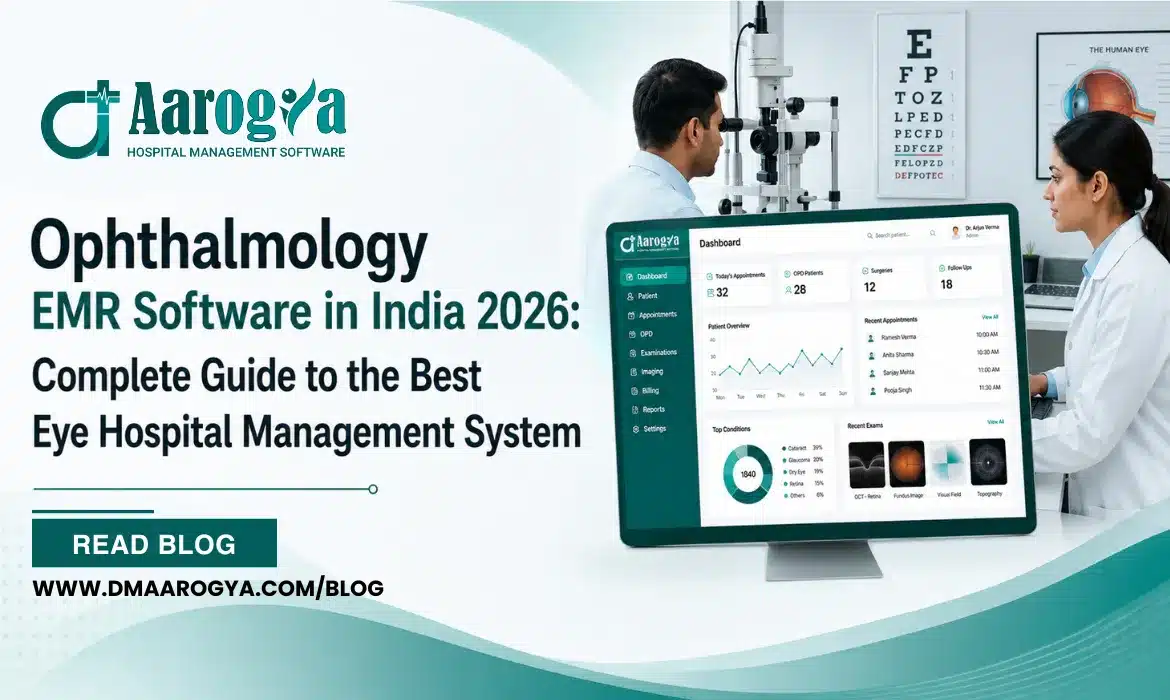
Table of Contents
ToggleIf you’re looking for the Ophthalmology EMR Software, you’re probably looking for a more efficient, structured, and clinically correct approach to run your eye hospital or clinic. Ophthalmology is one of the most expensive specialties in healthcare. A typical patient appointment may include registration, optometry, refraction, diagnostics such as OCT and Fundus photography, dilatation, consultation, counseling, surgery planning, billing, and follow-up.
When these operations are done manually or using generic software, it frequently results in duplicate entries, lengthier wait times, missed clinical details, and operational inefficiencies.
This is when specialized ophthalmology EMR software comes in handy.
Purpose-built systems, such as Aarogya Eye Module, offer specialized eye-specific workflows, organized documentation, imaging integration, operation scheduling, and package billing all within a single platform.
To understand the global significance of electronic medical records, read more at World Health Organization – Digital Health and Electronic Health Record .

What is ophthalmology EMR software?
Ophthalmology EMR Software is a specialist electronic medical record and practice management system created specifically for eye hospitals, ophthalmologists, retina clinics, cataract centers, LASIK practices, and multi-specialty hospitals that have ophthalmology departments.
Unlike generic hospital software, ophthalmology EMR solutions have dedicated fields and workflows for:
Visual Acuity (VA)
Refraction (Re/LE)
Intraocular pressure, or IOP
Slit lamp inspection
Fundus discoveries.
OCT and imaging integration.
Cataract and LASIK surgery planning
Eyeglass prescriptions
Dilation tracking.
Counseling and Package Conversion
In simple terms, Ophthalmology EMR Software understands how eye care works and digitizes every step of the patient journey.
To understand how EMR systems improve healthcare documentation, read HealthIT.gov – Electronic Health Records.
Why Do Eye Hospitals Need Specialty Software?
Ophthalmology is a high-volume profession in which patients frequently transit across departments before receiving treatment.
A typical eye-care visit may include:
Registration
Visual acuity tests
Refraction
Optometrist Review
Diagnostics (OCT, Fundus, and Pachymetry)
Dilation
A consultation with a doctor
Counseling
Surgery booking
Billing
Pharmacy
Follow-up
Managing this journey with spreadsheets, paper files, or generic software can result in delays, duplicate entries, and ineffective coordination.
Specialized ophthalmology EMR software addresses these difficulties by integrating all departments into a single digital ecosystem
Common Issues Without Ophthalmology Software.
Long wait times.
Missing diagnostic pictures
Duplicate documentation.
Uncertain surgical planning
Billing mismatches
Missed follow-up opportunities
Poor counseling conversion.
Lack of visibility into patient flow
What Changes After Implementation
Faster consultation workflows
Seamless image integration
Better surgery coordination
Accurate package billing
Real-time patient tracking
Improved patient satisfaction

Key Features of Ophthalmology EMR Software
The greatest ophthalmology EMR software should do more than just save patient information. It should digitize the entire eye-care workflow.
1. Patient Registration and ABHA Integration
Quickly capture demographics, contact information, ABHA ID, referral source, and branch information.
Read more about the Ayushman Bharat Health Account (ABHA)
2. Visual Acuity and Refraction.
Dedicated forms for RE/LE include:
Sphere
Cylinder Axis
Near and distant vision
3. Consultation EMR.
Doctors can record:
Major complaints
History
Slit lamp findings
Fundus observations.
Diagnosis
Treatment Plan
4. Diagnostics Integration
It integrates with:
OCT
Fundus Camera
A-Scan
B-Scan
Pachymetry Topography
5. Dilation Management.
Automated timers and warnings ensure that patients are seen at the appropriate times.
6. Counseling & Conversion Tracking
Monitors package estimates, patient decisions, and surgery acceptability.
7. Pre-anesthetic checkup (PAC)
Mandatory PAC forms guarantee that patients are fit before scheduling OT appointments.
8. Manage surgery bookings for cataract procedures.
LASIK
Retina Procedures
Glaucoma surgery
9. Eyeglass Prescription
Make print-ready optical prescriptions.
10. Package billing.
Transparent billing for
cataract packages
LASIK bundles.
Diagnostics
Pharmacy
11. Follow-up scheduling
SMS and WhatsApp reminders are automated.
12. Dashboards and analytics.
Track:
OPD volumes
Conversion rates:
Surgery counts
Revenue
outstanding dues

End-to-End Ophthalmology Workflow
A strong Ophthalmology EMR Software combines clinical, operational, and financial operations.
Registration and Triage
Patients are registered, given tokens, and routed based on the appointment type.
Assessment for Optometry
Optometrists measure visual acuity, refraction, and intraocular pressure (IOP).
Diagnostics
Doctors can order tests straight from the EMR.
Dilation
Timers automatically track preparedness.
Consultation
Ophthalmologists examine the findings and offer treatment.
Counseling
Patients receive package estimates and digital consent.
PAC clearance
Pre-surgical medical fitness is assessed.
Surgery scheduling
The OT calendar has been revised to reflect surgeon and room allocations.
Billing and pharmacy
All services are automatically billed.
Follow-up
Patients can view records and receive reminders through the patient app.
Benefits for Doctors, Hospitals, and Patients
For Ophthalmologists.
Doctors spend less time documenting and more time caring for their patients.
Benefits include:
Templates designed specifically for the eyes
Instant access to photos.
ready-made prescription templates
Faster surgical planning
For eye hospitals.
Hospitals gain more control over their operations and revenues.
Benefits include:
Increased patient throughput.
Improved counseling conversions
Better bundle charging.
Real-time analytics.
For patients.
Patients have a smoother journey.
Benefits include:
Shorter wait times.
Clear prescriptions.
Transparent billing.
Timely reminders
Aarogya Eye Module: Built for Modern Eye Care
Aarogya Eye Module is a specialty-driven extension of Aarogya HIMS designed exclusively for ophthalmology.
If you are searching for the best Ophthalmology EMR Software, Aarogya Eye Module combines clinical depth with operational efficiency.
Explore Aarogya Eye Module here: Aarogya Eye Module
Specialty-Driven Features
Eye-specific EMR templates
Optometry workflows
Diagnostics integration
Dilation dashboards
Counseling conversion tracking
PAC and surgery controls
Package billing
Patient and doctor mobile apps
Supported Use Cases
Cataract hospitals
Retina clinics
LASIK centers
Glaucoma practices
Pediatric ophthalmology
Multi-specialty hospitals

ABHA & ABDM Integration in Eye Hospitals
India’s digital healthcare ecosystem is built around the Ayushman Bharat Digital Mission.
Ophthalmology EMR Software should support:
ABHA creation and linking
Digital prescriptions
Health record sharing
Consent-based access
Read more at Ayushman Bharat Digital Mission.
Benefits of ABDM integration:
Better continuity of care
Standardized data exchange
Improved patient access to records
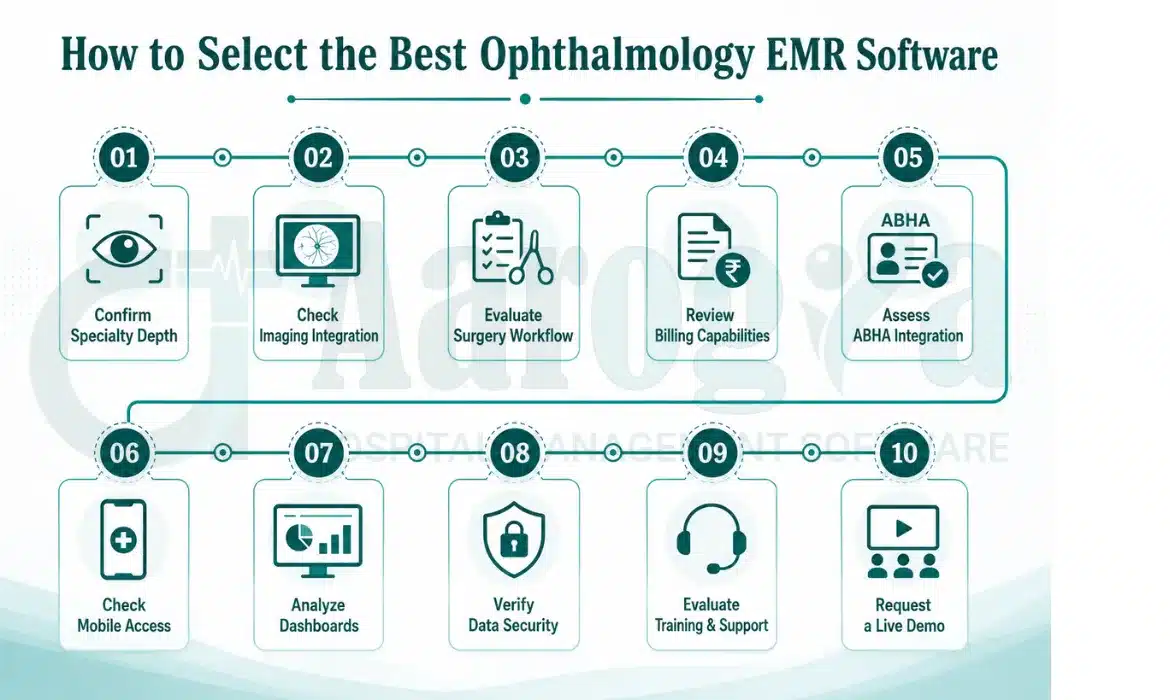
How to Choose the Right Ophthalmology EMR Software
Selecting the right software is a strategic decision.
1. Confirm Specialty Depth
Ensure the software supports ophthalmology-specific documentation.
2. Check Imaging Integration
Verify compatibility with OCT and Fundus devices.
3. Evaluate Surgery Workflow
Look for PAC, counseling, and OT scheduling features.
4. Review Billing Capabilities
Confirm package billing and insurance support.
5. Assess ABHA Integration
Choose ABDM-ready software.
6. Check Mobile Access
Doctor and patient apps improve convenience.
7. Analyze Dashboards
Reports should provide operational insights.
8. Verify Data Security
Ensure role-based access and audit trails.
9. Evaluate Training & Support
Implementation success depends on ongoing support.
10. Request a Live Demo
Always test real workflows before purchasing.
Future of Digital Ophthalmology
Eye care is evolving rapidly with technology.
Key trends include:
AI-assisted retinal screening
Automated diagnostics
Teleophthalmology
Cloud-based imaging
Predictive analytics
Patient self-service apps
Research in digital ophthalmology continues to expand. Read more at PubMed – Ophthalmology Informatics Research.
Hospitals adopting specialized Ophthalmology EMR Software today will be better positioned for future innovations.

Conclusion
Choosing the right Ophthalmology EMR Software can transform the way your eye hospital operates. Instead of relying on fragmented systems, your team can manage registration, optometry, diagnostics, consultation, counseling, surgery, billing, pharmacy, and follow-up in one integrated platform.
For ophthalmologists, this means faster documentation and better clinical decision-making. For hospital administrators, it means improved operational control, transparent package billing, and higher counseling conversions. For patients, it means shorter waiting times, clearer communication, and a smoother treatment journey.
Solutions like Aarogya Eye Module are purpose-built for modern eye care. Whether you run a cataract hospital, retina center, LASIK clinic, or multi-specialty institution, Aarogya provides the specialty workflows, imaging integration, ABHA connectivity, and analytics needed to deliver precision care efficiently.
If you are looking for the best Ophthalmology EMR Software to digitize your practice and improve both clinical and financial outcomes, Aarogya Eye Module offers a complete, scalable, and future-ready solution.
FAQs
1.What are the advantages of ophthalmology EMR software?
It aids in the digitization of patient records and increases workflow efficiency in eye hospitals and clinics.
2.Can the ophthalmology EMR manage diagnostic images?
Yes, it can work with OCT, Fundus, and other ophthalmic devices.
3.Does the software support appointment scheduling?
Yes, it improves appointment, follow-up, and patient scheduling efficiency.
4.Is ophthalmology EMR appropriate for multi-branch hospitals?
Yes, it enables centralized management of various clinics and hospital branches.
5.How does ophthalmology EMR enhance patient care?
It enables Quick access to patient records, prescriptions, and diagnostic history.
Categories
Recent Posts
-
 28 Sep 2026What is NABH? Full Form, Accreditation, Certification & NABH-Certified HMS Explained
 -
08 Sep 2026EMR Software: What It Is, How It Works, Key Benefits, Features, and the Future of Digital Healthcare
-
16 Aug 2026What Is a Kiosk Machine? Smart Kiosks in Healthcare | Aarogya
-
27 Jul 2026Patient Drug Registry, Unified Health Interface (UHI) & NHCX FHIR: How Aarogya HMIS Can Power India's Next Generation Digital Healthcare
-
29 Jun 2026Best HMIS Software in Kolkata 2026: How Digital Healthcare Is Transforming Patient Care Across the City
-
25 Jun 2026Best Bank Reconciliation Software | Automated Bank Reconciliation with Aarogya
-
04 Jun 2026Best Hospital Management Software(HMIS) in Kanpur 2026: Complete Guide to Modern HMIS Solutions
-
26 May 2026Ophthalmology EMR Software in India 2026: Complete Guide to the Best Eye Hospital Management System
-
22 May 2026What is NABH? Full Form, Digital NABH, NHCX & HMIS Integration Explained (2026)
-
06 May 2026Best HMIS Software in Bangalore 2026: Complete Guide to Choosing the Right Hospital Management System