What is NABH? Full Form, Digital NABH, NHCX & HMIS Integration Explained (2026)
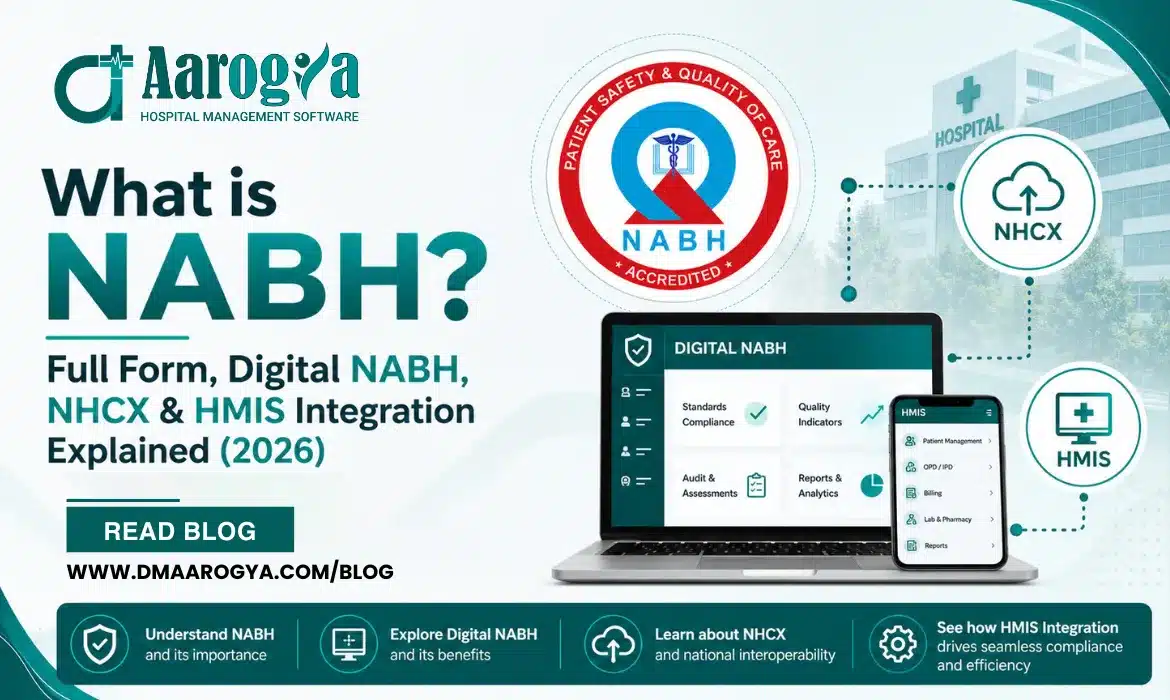
Table of Contents
ToggleThe NABH full form in healthcare is National Accreditation Board for Hospitals & Healthcare Providers. It is India’s leading accreditation authority that ensures quality healthcare and patient safety standards in hospitals.
With the rise of digital healthcare and initiatives like ABDM, hospitals are adopting Digital NABH, NHCX integration, and advanced HMIS solutions to improve compliance, insurance claim processing, and operational efficiency.
Manual hospital processes often lead to documentation errors, delayed claims, and compliance challenges. This is where platforms like Aarogya HMIS help by digitizing patient records, billing, insurance workflows, compliance tracking, and reporting within a unified system.
As healthcare becomes more technology-driven, Digital NABH and NHCX are helping hospitals achieve better efficiency, transparency, and patient care outcomes.
What is NABH in Healthcare?
The NABH full form in healthcare stands for National Accreditation Board for Hospitals & Healthcare Providers.
NABH is a constituent board of the Quality Council of India and is responsible for establishing quality standards and accreditation frameworks for healthcare organizations across India.
NABH accreditation ensures that hospitals follow standardized protocols related to:
Patient safety
Clinical quality
Infection control
Documentation standards
Staff training
Operational processes
Healthcare ethics
Hospitals accredited by NABH demonstrate a commitment to delivering safe, high-quality, and patient-centric healthcare services.
What is Digital NABH?
Digital NABH refers to the use of digital technologies and HMIS platforms to manage NABH compliance electronically instead of using manual or paper-based processes.
Traditional NABH management involved:
Physical files
Manual checklists
Paper audit reports
Offline documentation tracking
Digital NABH modernizes this process through:
Electronic Medical Records (EMR)
Automated compliance tracking
Digital audit logs
Real-time reporting
Centralized documentation systems
Importance of Digital NABH
Digital transformation significantly simplifies accreditation management for hospitals.
Key Benefits of Digital NABH
Reduced paperwork and manual documentation
Faster audit preparation
Real-time compliance monitoring
Improved operational transparency
Better patient safety management
Easier report generation
Centralized hospital records
Hospitals adopting Digital NABH frameworks are better prepared for continuous compliance instead of managing accreditation only during audit periods.
What is NABH Accreditation Software?
NABH Accreditation Software is a specialized healthcare technology solution designed to help hospitals manage accreditation standards, documentation, audits, and compliance workflows digitally.
A modern Hospital Accreditation Software solution helps hospitals:
Track NABH standards
Manage department-wise compliance
Maintain digital documentation
Generate audit-ready reports
Monitor infection control processes
Maintain staff training records
Automate compliance alerts
When integrated with HMIS platforms, accreditation software becomes part of a complete digital healthcare ecosystem.
Also read : Best HMIS in Bangalore Blog
This integration enables hospitals to:
Reduce manual workload
Improve documentation accuracy
Enhance audit readiness
Strengthen insurance claim workflows
What is NHCX in Healthcare
The National Health Claims Exchange (NHCX) is a government-led initiative designed to create a standardized digital platform for health insurance claims processing in India.
In simple terms, NHCX acts as a centralized digital communication framework connecting:
Hospitals
Insurance companies
Third-Party Administrators (TPAs)
The objective is to create faster, transparent, and interoperable insurance workflows.
Previously, hospitals faced challenges such as:
Manual claim documentation
Delayed approvals
Frequent claim rejections
Lack of claim visibility
Multiple insurer-specific processes
NHCX addresses these inefficiencies through standardized digital workflows and interoperable healthcare data exchange.
For additional insights into healthcare interoperability and information systems, refer to NCBI – Healthcare Information Systems Research.
Importance of NHCX for Hospitals
Insurance claims are one of the most critical financial workflows in hospitals. Even small inefficiencies can lead to major revenue delays.
NHCX addresses this by introducing standardization and automation.
Why NHCX is Important
Faster Claim Approvals
Digital workflows reduce delays in approvals and settlements.Reduced Claim Rejections
Standard formats minimize documentation errors.Transparency Across Systems
Hospitals can track claim status in real time.Improved Cash Flow
Faster reimbursements lead to better financial stability.
Enhanced Patient Experience
Patients benefit from smoother discharge and billing processes.
Real Use Cases of NHCX
NHCX is more than simply a theoretical framework; it directly improves hospital operations.


1. Hospitalization without using cash
Patients who choose insurance-based treatments benefit from faster approvals and shorter waiting times.
2. Requests for Prior Authorization
Hospitals can submit treatment estimates online and receive approvals without having to follow up manually.
3. Making Digital Claims Submissions
All claim-related documents are submitted in a standardized digital format.
4. Faster Discharge Procedure
Final billing approvals are rapidly processed, decreasing patient wait times.
5. Auditing and Compliance
Standardised digital records make auditing and regulatory compliance easier.

What is NABH & Digital NABH
The NABH is India’s benchmark for hospital quality and patient safety.
NABH accreditation guarantees that hospitals follow stringent criteria in
Patient safety and care.
Documentation Standards
Infection control
Staff Training and Management
Operational processes
Key Benefits
Reduced documentation burden.
Eliminates the need for physical file management.
Improved audit readiness.
Every record is instantly available.
Continuous Compliance
Hospitals ensure compliance at all times, not just during audits.
Improved Patient Safety
Standardized workflows reduce risk.
Operational Efficiency
Automation lowers the number of repetitive manual processes.

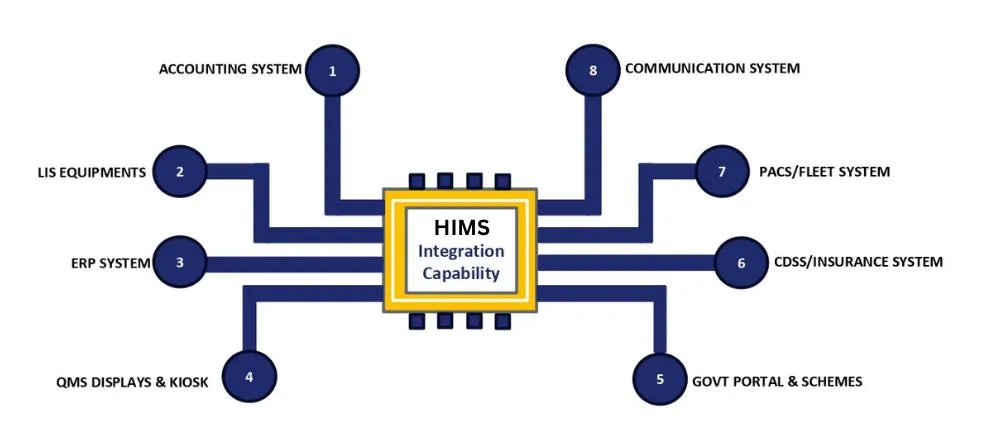
How HMIS Supports NHCX & NABH
This is the most critical connection in modern healthcare.
NHCX and NABH cannot function correctly without a solid digital system.
Read : What is HMIS Blog
HMIS’s involvement within NHCX.
Creates well-organized billing data.
Automates insurance workflows.
Standardizes the documentation.
Connects with insurers and third-party administrators.
The HMIS role in NABH involves managing electronic medical records (EMR).
Monitors audit logs and user activity.
Monitors standard operational processes and compliance checklists.
Monitors infection-control procedures.
Generates compliance reports rapidly.

Why Aarogya HMIS for Compliance & Claims
Not every HMIS platform is designed to manage insurance claims and compliance requirements efficiently.
Aarogya HMIS is specifically built to meet the needs of modern hospitals, including the NHCX and NABH framework.
How Aarogya HMIS helps
Automates insurance workflows from admission to discharge.
Creates claim-ready billing data.
maintains structured digital patient records.
Delivers audit-ready compliance reports.
Allows role-based secure access.
Supports ABDM-aligned digital standards.
What Makes Aarogya Different
End-to-end hospital workflow integration
Real-time dashboards and analytics.
Reduced manual errors.
Faster claim processing
Continuous compliance monitoring
This elevates Aarogya to the status of a whole digital healthcare ecosystem, rather than merely software.

Implementation Approach for Hospitals
Adopting NHCX and Digital NABH requires a structured implementation approach.
Step-by-Step Process
Assess Current Systems
Identify gaps in claims processing and compliance.Select the Right HMIS
Choose a scalable and compliant system like Aarogya.Data Migration
Transfer patient records, billing data, and operational details.System Integration
Integrate HMIS with insurers, labs, and other systems.Staff Training
Train doctors, nurses, and administrators.Testing & Validation
Ensure system accuracy and performance.
Go-Live & Monitoring
Deploy system and continuously monitor performance.

Future of Digital Healthcare in India.
India’s healthcare environment is transitioning to a fully digitized and interoperable system.
Key trends include:
AI-based diagnostics
Predictive Analytics for Patient Care
Real-time exchange of health data.
Digital Insurance Ecosystems
Automated compliance systems.
NHCX and NABH will become crucial to hospital operations, while HMIS systems will serve as the backbone that connects everything.
Hospitals that implement digital technologies early will profit from:
Faster operations.
Better compliance.
Increased patient satisfaction.
Long-term Scalability

Conclusion
Healthcare is no longer only about treatment; it is about efficiency, openness, and compliance.Frameworks such as the National Health Claims Exchange and the National Accreditation Board for Hospitals and Healthcare Providers are altering the way hospitals operate in India.
However, these systems cannot work properly unless they are built on the proper digital base.
The base is a robust HMIS framework. Aarogya HMIS is a solution that combines Claims Processing, Compliance management, Patient records, Billing and analytics.
By using the appropriate HMIS, hospitals may eliminate claim delays, easily maintain compliance, and improve patient care results.
As the healthcare business evolves, digital transformation will not be optional; it will be required. Hospitals that invest in the proper technology today will be at the forefront of healthcare innovation tomorrow.
FAQs
1. What is NHCX?
NHCX is a digital platform for standardized health insurance claims processing.
2. What is Digital NABH?
It is the use of technology to manage NABH compliance digitally.
3. How does HMIS help in NHCX?
HMIS automates billing, documentation, and claim workflows.
4. Can small hospitals adopt Digital NABH?
Yes, scalable HMIS systems make it possible.
5. Is Aarogya HMIS compliant with digital standards?
Yes, it supports modern healthcare frameworks and workflows.
Categories
Recent Posts
-
 28 Sep 2026What is NABH? Full Form, Accreditation, Certification & NABH-Certified HMS Explained
 -
08 Sep 2026EMR Software: What It Is, How It Works, Key Benefits, Features, and the Future of Digital Healthcare
-
16 Aug 2026What Is a Kiosk Machine? Smart Kiosks in Healthcare | Aarogya
-
27 Jul 2026Patient Drug Registry, Unified Health Interface (UHI) & NHCX FHIR: How Aarogya HMIS Can Power India's Next Generation Digital Healthcare
-
29 Jun 2026Best HMIS Software in Kolkata 2026: How Digital Healthcare Is Transforming Patient Care Across the City