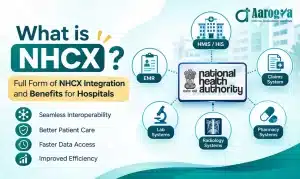
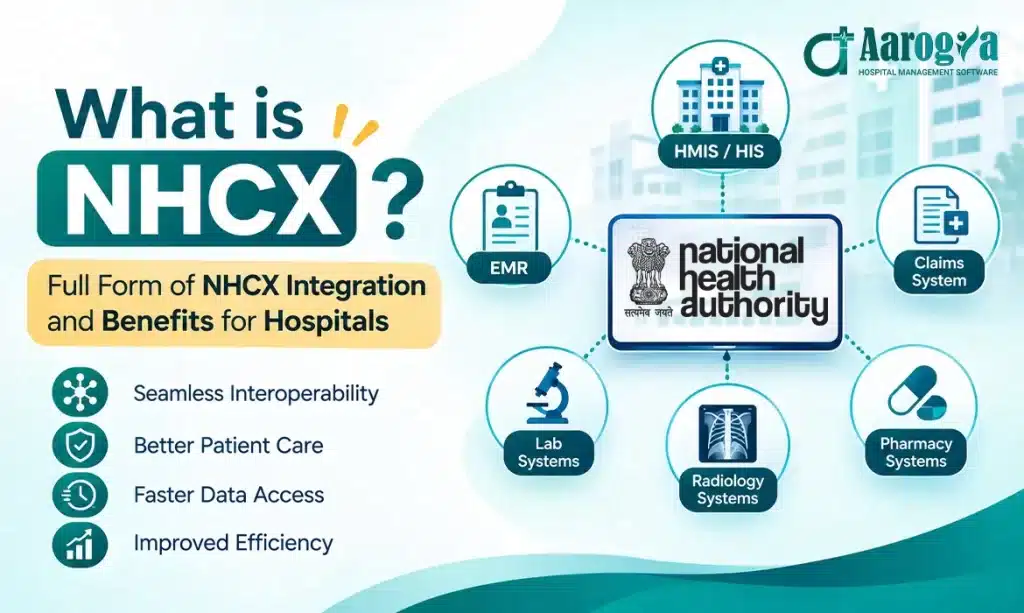
What is NHCX, Full Form of NHCX Integration and Benefits for Hospitals

Table of Contents
ToggleIntroduction: Is Your Hospital Ready for the Future of Digital Health Claims?
Health insurance claims involve more than submitting a bill. Hospitals must coordinate patient information, clinical documentation, pre-authorisation, treatment charges, claim submissions, payer queries and settlement records. When these processes operate across disconnected systems, administrative work becomes more complicated.
The National Health Claims Exchange (NHCX) aims to bring greater standardisation to health insurance claim information exchange in India. Developed under the Ayushman Bharat Digital Mission (ABDM), it provides a digital framework for participating healthcare providers, insurers and other stakeholders to exchange claim-related information using defined standards.
For hospitals planning their digital transformation, this raises an important question: Can your hospital management software support accurate billing, organised insurance workflows and the technical requirements of digital claims exchange?
Aarogya HMIS brings hospital workflows such as patient management, billing, diagnostics and accounts into an integrated platform. For hospitals evaluating their digital readiness, exploring Aarogya Hospital Management Software is a useful starting point for understanding how connected hospital operations can support better-managed workflows.
In this guide, we explain what NHCX is, how it works, the role of FHIR, its potential benefits for hospitals and the factors to evaluate before implementing an NHCX-connected solution.
1. What Is NHCX?

NHCX stands for National Health Claims Exchange. It is a digital platform developed under ABDM to standardise the exchange of health insurance claim information between participating healthcare providers, payers and other relevant stakeholders.
Traditionally, hospitals may exchange insurance information through different software systems, portals and document formats. This can require staff to enter information repeatedly, follow up on pending requests and coordinate claim updates across separate systems.
NHCX aims to provide a common digital exchange framework, allowing connected systems to exchange health claim information in a more structured and interoperable manner.
Its intended workflows include eligibility checks, pre-authorisation requests, claim submissions, communication, status-related exchanges and payment notifications. The precise workflows available depend on the applicable specifications and implementation.
For hospitals, NHCX is important because insurance processing depends on information generated throughout the patient journey. Patient registration, clinical documentation, billing and discharge records all contribute to the claim process.
Why does NHCX matter now?
India’s digital healthcare ecosystem is moving towards more standardised information exchange. The National Health Authority’s NHCX initiatives and implementation resources reflect the growing focus on interoperable digital claims processing.
In March 2026, the Government of India reported that the NHCX Hackathon and Innovation Meet brought together healthcare, insurance and technology stakeholders to develop solutions for standardised health claims processing. This demonstrates the continuing work to expand the NHCX ecosystem.
Read: Government of India — NHCX Innovation Meet and Hackathon.
2. How Does NHCX Work?
NHCX supports the exchange of information across defined health insurance claim workflows. A simplified hospital-side process looks like this:
Patient Registration → Eligibility Check → Pre-authorisation → Treatment and Documentation → Claim Submission → Payer Review → Payment Notification → Reconciliation
Patient Registration and Insurance Verification
The hospital captures the patient’s relevant details and insurance information. Accurate identifiers and policy information help establish the foundation for the subsequent claim workflow.
Pre-authorisation
Where required, the hospital submits a pre-authorisation request through the applicable connected process. The payer reviews the request and responds according to its requirements and the relevant policy conditions.
Treatment and Billing
During the patient’s stay, clinical services, investigations, procedures and charges are documented. The hospital needs to ensure that the final bill is consistent with the services provided and the supporting records.
Claim Submission and Communication
The hospital submits the claim and required information through the applicable NHCX-enabled workflow. The payer may return a decision, request additional information or communicate another status update.
Payment and Reconciliation
After the claim is processed, the hospital reviews the payment information and reconciles the amount received against the bill, claim and accounts records.
NHCX supports the exchange of information; it does not independently guarantee approval, eliminate all claim queries or determine the time required for settlement.
3. What Is the Role of FHIR in NHCX?
FHIR stands for Fast Healthcare Interoperability Resources. It is a standard used to represent and exchange healthcare information electronically.
NHCX uses defined FHIR-based specifications to help participating systems exchange claim information in a structured, machine-readable format.
For example, a claim may contain financial information, service details, supporting clinical information and communication records. Standardised structures help the receiving system interpret these details consistently.
FHIR is important because digital exchange is not simply about transferring a document from one organisation to another. Systems also need a shared understanding of the information being exchanged.
FHIR-based specifications can support:
Structured representation of claim information
Consistent data exchange between participating systems
Validation against applicable profiles
More systematic handling of claim requests and responses
Traceability of digital exchanges
However, FHIR support alone does not prove that a software product is NHCX-integrated or compliant. The actual implementation must meet the relevant NHCX requirements and applicable testing and onboarding processes.
For the technical details, refer to the official NHCX profiles and implementation guidance.
4. What Are the Benefits of NHCX for Hospitals?
NHCX is intended to make health claim information exchange more standardized. The practical benefits depend on how well participating systems are integrated and how accurately organisations capture and exchange information.
More Structured Claim Submission
Defined data formats can help hospitals prepare and exchange claim information consistently, provided their systems are correctly configured.
Reduced Repetitive Administrative Work
Where information is captured once and mapped correctly between connected systems, staff may spend less time entering the same details into multiple applications.
Better Claim Tracking
Structured digital communication can support the tracking of requests, responses and status updates through the implemented workflow.
Improved Coordination Between Departments
Insurance claims depend on information from registration, clinical documentation, billing and accounts. Integrated hospital software can help teams coordinate these activities more systematically.
Better Financial Reconciliation
Connecting claim information with billing and accounts can help the finance team compare claimed amounts, payer responses, deductions and settlements.
A Foundation for Interoperability
Standardised exchange specifications provide a common technical foundation for participating systems to communicate without relying entirely on individually designed formats.
These are potential operational benefits, not guarantees of faster approvals or settlement. Results depend on data quality, payer processes and implementation readiness.

5. NHCX Integration with Hospital Management Software
NHCX integration is not just an external technical connection. Hospitals also need internal systems that can capture, organise and supply the information required by the relevant claim workflows.
This is where an integrated hospital management information system (HMIS) becomes important.
A hospital may use separate tools for registration, billing, laboratory, radiology, insurance and accounts. If these tools are disconnected, collecting information for a claim may involve repeated entry and manual coordination.
An integrated HMIS can help connect these internal workflows. Where the appropriate NHCX integration is implemented, relevant data can then be mapped and exchanged according to the applicable specifications.
What should hospitals evaluate?
Before selecting an NHCX-connected solution, review whether it supports:
- Accurate patient, provider and payer information
- Structured clinical and discharge documentation
- Itemised billing and financial information
- Mapping to applicable NHCX/FHIR specifications
- Request and response handling
- Error monitoring and status tracking
- Appropriate access controls and audit trails
- Reconciliation of claim and payment information
A hospital should also confirm the software’s actual NHCX implementation status, supported workflows, testing status and production-readiness requirements with the vendor.
Explore related hospital workflows:
These pages explain Aarogya’s broader HMIS, TPA and accounts capabilities. They should not be interpreted as confirmation of NHCX integration unless the product team has verified that status.
6. NHCX vs Traditional Health Insurance Claim Processing
The main difference is the emphasis on standardised digital exchange rather than relying solely on disconnected communication methods
| Area | Disconnected or Manual Processes | NHCX-enabled Workflows |
|---|---|---|
| Data Exchange | May involve different formats and channels | Uses defined exchange specifications |
| Claim Information | May require repeated entry | Can be mapped and exchanged between connected systems |
| Communication | May be spread across separate tools | Can follow structured digital workflows |
| Status Tracking | May depend on manual follow-up | Can support digital request and response tracking |
| Integration | May require individual system-to-system arrangements | Provides a common exchange framework for participating systems |
The table is a general comparison, not a guarantee that every traditional process is manual or that every NHCX-enabled implementation automates all listed activities.
NHCX does not replace the hospital’s HMIS, insurer’s claims system or the need for proper documentation. Instead, it provides a standardised framework through which participating systems can exchange relevant claim information.
7. What Should Hospitals Do Before NHCX Implementation?
Successful implementation requires operational preparation as well as technical integration.
Step 1: Map the current process. Document how the hospital manages eligibility, pre-authorisation, billing, claim submission, payer queries and settlement.
Step 2: Assess the HMIS. Check whether the system can capture and retrieve the necessary clinical, administrative and financial information.
Step 3: Improve data quality. Review patient identifiers, payer information, service details and supporting documents for completeness and consistency.
Step 4: Review technical requirements. Use the current official implementation documentation to identify relevant specifications, APIs, security requirements, testing and onboarding steps.
Step 5: Test end-to-end scenarios. Test eligibility, pre-authorisation, claims, responses, communication and payment-related workflows as applicable.
Step 6: Prepare the team. Define responsibilities for the insurance desk, billing team, clinical departments and finance team.
Step 7: Monitor performance after implementation. Track integration errors, missing information, unresolved queries and reconciliation differences.
For technical planning, start with the NHCX FHIR Implementation Guide and the Government of India’s NHCX updates.

8. How Aarogya HMIS Supports Connected Hospital Workflows
Preparing for digital claims exchange begins with the quality and organisation of the hospital’s own data.
Aarogya HMIS by Dataman provides hospital management capabilities across areas such as patient management, OPD, IPD, diagnostics, radiology, TPA and accounts. These workflows are relevant to the information hospitals use when managing patient billing and insurance claims.
A connected HMIS approach can help hospitals coordinate operational and financial information more systematically. For an NHCX implementation, the hospital must separately confirm whether the required technical integration, testing and onboarding have been completed.
If your hospital is reviewing its digital infrastructure, explore Aarogya HMIS and learn more about its TPA management capabilities.
Conclusion: Build Your Hospital’s Digital Claims Readiness with Aarogya HMIS
NHCX is an important development in India’s move towards standardised digital health insurance claims. By enabling participating systems to exchange claim information using defined specifications, it aims to improve interoperability and make communication across the claims process more structured.
But digital claims exchange works best when the hospital’s internal processes are ready. Accurate patient information, complete clinical documentation, connected billing, reliable financial records and a well-prepared team all matter.
Aarogya HMIS by Dataman helps hospitals bring key operational and financial workflows together on an integrated platform. If your hospital is evaluating its HMIS, billing or TPA workflows as part of its digital transformation, explore Aarogya Hospital Management Software and Aarogya TPA Management.
Speak with the Aarogya team to understand the product’s current capabilities and confirm the specific requirements for your hospital’s NHCX implementation.
Frequently Asked Questions About NHCX
1. What is NHCX?
NHCX stands for National Health Claims Exchange. It is a digital platform developed under ABDM to support the standardised exchange of health insurance claim information.
2. What is the purpose of NHCX?
3. Is NHCX part of ABDM?
4. What is NHCX FHIR?
5. Does NHCX replace hospital management software?
No. HMIS manages internal hospital workflows such as registration, clinical documentation and billing. NHCX provides a framework for exchanging health insurance claim information between participating systems.
6. Does every HMIS support NHCX?
7. Does NHCX guarantee faster claim settlement?
No. NHCX aims to support standardised information exchange, but claim decisions and settlement depend on documentation, policy terms, payer review and the implementation of connected systems.
8. How can a hospital prepare for NHCX?
Hospitals should assess HMIS readiness, improve data quality, review current technical requirements, test the necessary workflows and train the teams involved in insurance claim management.
Categories
Recent Posts
-
 03 Nov 2026What is NHCX, Full Form of NHCX Integration and Benefits for Hospitals
-
31 Oct 2026Best PACS Software for Hospitals: PACS Integration with RIS and HMIS
-
13 Oct 2026TPA Claim Approvals Made Easy with Hospital Billing Software
-
28 Sep 2026What is NABH? Full Form, Accreditation, Certification & NABH-Certified HMS Explained
-
08 Sep 2026EMR Software: What It Is, How It Works, Key Benefits, Features, and the Future of Digital Healthcare
-
16 Aug 2026What Is a Kiosk Machine? Smart Kiosks in Healthcare | Aarogya
-
27 Jul 2026Patient Drug Registry, Unified Health Interface (UHI) & NHCX FHIR: How Aarogya HMIS Can Power India's Next Generation Digital Healthcare
-
29 Jun 2026Best HMIS Software in Kolkata 2026: How Digital Healthcare Is Transforming Patient Care Across the City
-
25 Jun 2026Best Bank Reconciliation Software | Automated Bank Reconciliation with Aarogya
-
04 Jun 2026Best Hospital Management Software(HMIS) in Kanpur 2026: Complete Guide to Modern HMIS Solutions