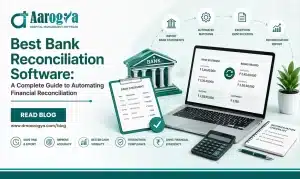
Best Bank Reconciliation Software: A Complete Guide to Automating Financial Reconciliation
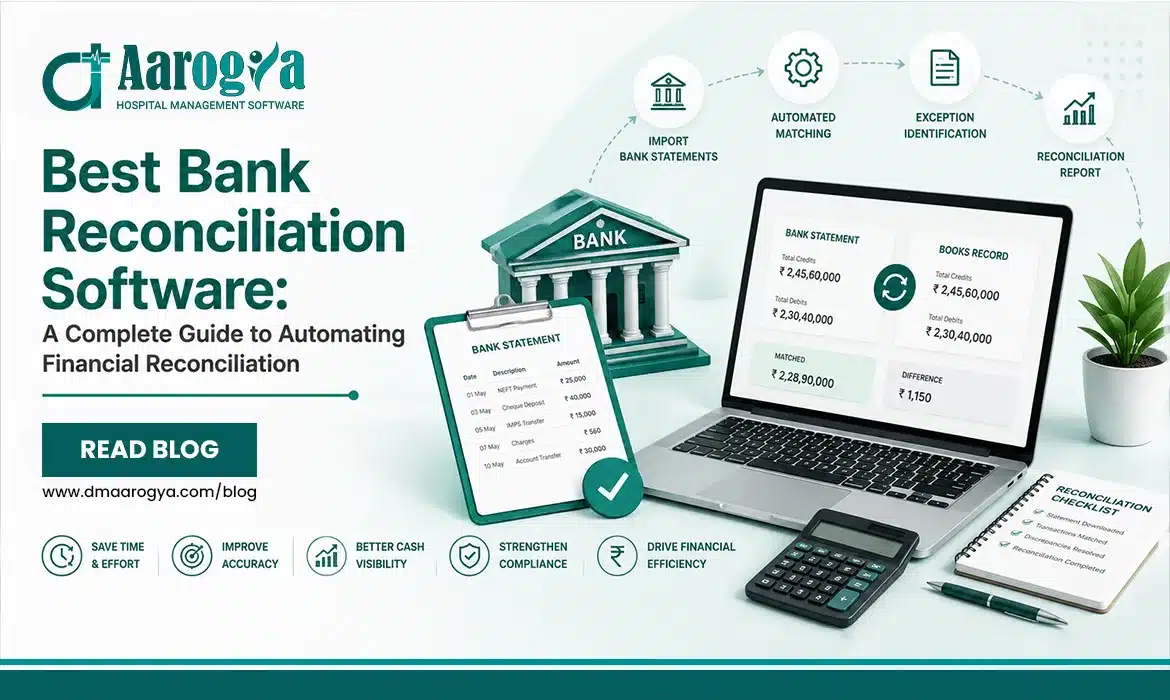
Table of Contents
ToggleBest Bank Reconciliation Software: Does Your Finance Team Still Spend Hours Matching Transactions?
Bank reconciliation software is becoming a necessary component of modern financial management. Spreadsheets, manual verification, and endless transaction matching gradually slow down operations in any developing firm.
Have you ever spent hours reviewing bank accounts and accounting records just to find a few transactions that do not match? You are not alone.
As firms execute more digital payments, vendor settlements, refunds, transfers, insurance reimbursements, and internet transactions, manual reconciliation becomes more challenging. This is why firms are investing heavily in Automated Bank Reconciliation Software to streamline financial operations and enhance accuracy.
At Aarogya, we recognized this challenge early and introduced Automatic Bank Reconciliation to help organizations automate transaction matching, reduce reconciliation effort, and improve financial visibility.
What is Bank Reconciliation Software?
Bank reconciliation is the process of reconciling transactions recorded in your accounting system to the transactions shown in your bank account.
According to the notion of bank reconciliation as defined by Bank Reconciliation on Wikipedia, reconciliation assists organizations in identifying anomalies and keeping correct financial records.
Bank Reconciliation Software streamlines this process.
Instead of manually evaluating each transaction, the software imports bank data, compares records, finds discrepancies, and provides reconciliation reports.
Modern reconciliation software can do:
- Automatically import bank statements.
- Match transactions immediately.
- Detect duplicate entries
- Identify any missing transactions.
- Create audit-ready reports
- Maintain the whole reconciliation history.
Organizations frequently combine reconciliation with Finance Management, Account Management, Financial Reporting, ERP Systems, and User Management platforms to develop a connected financial ecosystem.
Why Bank Reconciliation Matters More Than Ever
Financial accuracy impacts every aspect of business performance.
A small discrepancy in financial records can create larger problems in reporting, compliance, audits, and decision-making.
According to Accounting on Wikipedia , maintaining accurate financial records is one of the most important foundations of financial management.
Similarly, Financial Statements depend on accurate transaction recording and reconciliation.
Without proper reconciliation, organizations may face:
- Missing transactions
- Duplicate entries
- Incorrect account balances
- Delayed reporting
- Compliance concerns
- Reduced cash flow visibility
Did You Know?
Many finance teams spend a significant portion of their month-end close activities reconciling transactions and resolving discrepancies.
Common Challenges of Manual Bank Reconciliation
While spreadsheets have traditionally been used for reconciliation, they become difficult to manage as transaction volumes increase.
- Missing Transactions
A transaction may appear in the bank statement but not in accounting records.
This often requires manual investigation.
- Duplicate Entries
Duplicate postings can distort financial reports and create reconciliation issues.
- Delayed Month-End Closing
Manual reconciliation often slows financial reporting cycles.
- Human Errors
Even experienced accountants can overlook transactions when processing large data volumes.
- Limited Visibility
Organizations may only identify discrepancies after financial reports are prepared.

How Automated Bank Reconciliation Works
A defined workflow is followed by modern automated bank reconciliation software.
Step 1: Gathering Bank Information
Statements from banks are automatically loaded.
Step 2: Matching Transactions
Accounting or ERP records are used to compare transactions.
Step 3: Identifying Exceptions
Unmatched entries are found right away.
Step 4: Evaluation and Acceptance
Reconciliation results are approved by finance teams after they examine exceptions.
Step 5: Reporting
For auditing purposes, reports are automatically generated and saved.
Accuracy is increased and repetitious manual labor is eliminated by this automated approach.

Key Benefits of Bank Reconciliation Software
Quicker Month-End Closures
Financial closure tasks can be finished by organizations faster.
Enhanced Precision
The possibility of human error is greatly decreased by automation.
Improved Visibility of Cash Flow
Making decisions requires an understanding of cash flow.
The principles of Cash flow management emphasize the significance of precise financial monitoring.
Enhanced Efficiency
Finance teams spend more time evaluating business performance and less time matching transactions.
Improved Financial Management
Automation strengthens responsibility and controls.

Were You Aware?
When opposed to spreadsheet-based procedures, organizations that use automation frequently see a significant reduction in reconciliation effort.
Why Healthcare Organizations Need Automated Reconciliation
Healthcare organizations manage some of the most complex financial transactions across industries.
A typical hospital processes:
Patient payments
Insurance settlements
Pharmacy collections
Laboratory revenue
Vendor payments
Government healthcare reimbursements
Corporate healthcare payments
Managing these transactions manually creates operational challenges.
Healthcare organizations using Hospital Management Software, Billing Management Systems, Finance Management Solutions, and Revenue Management Platforms can significantly improve efficiency through Automated Bank Reconciliation.
Introducing Automatic Bank Reconciliation in Aarogya
As healthcare and enterprise firms continue their digital transformation journeys, financial reconciliation should no longer rely on spreadsheets.
This is where Aarogya’s Automatic Bank Reconciliation is useful.
Automatically match transactions.
Identify discrepancies quickly.
Improve accounting accuracy.
Reduce the reconciling effort.
Accelerate month-end close
Improve financial visibility.
Improve financial governance.
Instead of manually comparing information, finance professionals receive access to intelligent automation that streamlines reconciliation from start to finish.
Organizations who already use Aarogya’s Finance Management, Accounts Management, Reporting, and Billing solutions can improve their operations with Automatic Bank Reconciliation.
Features to Look for in the Best Bank Reconciliation Software
Not all reconciliation systems provide the same capabilities.
When assessing the best bank reconciliation software, consider the following features:
- Automated Matching Engine
The system should automatically reconcile transactions. - Multi-Bank Support
Support several accounts and banking interactions. - Real-Time Reconciliation.
Increase visibility without waiting for month-end processing. - Reporting and Analytics
Create precise reconciliation reports and financial insights.
Financial Reporting, a resource from the Corporate Finance Institute’s Financial Reporting, emphasizes the necessity of accurate reporting. - Audit trails
Keep complete historical records. - User Access Controls
Role-based permissions help to ensure security and accountability. - ERP Integration
Connect smoothly to existing banking systems.
Manual vs Automated Reconciliation
Feature | Manual Reconciliation | Automated Bank Reconciliation Software |
Matching Process | Manual | Automatic |
Time Required | Hours or Days | Minutes |
Error Risk | High | Low |
Audit Trail | Limited | Complete |
Visibility | Delayed | Real-Time |
Reporting | Manual | Automated |
Scalability | Difficult | Easy |
The comparison clearly demonstrates why businesses are moving toward automation.
Compliance, Audits, and Financial Governance
Financial compliance requires accurate records, transparency, and accountability.
Organizations must maintain:
Transaction histories
Approval logs
Reconciliation reports
Supporting documentation
Audit trails
The IFRS Foundation promotes internationally recognized financial reporting standards.
Similarly, the Institute of Chartered Accountants of India ICAI provides guidance on accounting practices and financial governance.
Organizations also rely on Internal Control Frame works to strengthen financial oversight.
Automated reconciliation supports these requirements by maintaining complete and traceable records.
Future of Bank Reconciliation
Automation and intelligence will shape the future of reconciliation.
Key trends include:
Artificial Intelligence
Machine learning
Predictive Matching
Real-Time Reconciliation.
Intelligent Exception Handling.
Financial Analytics
Organizations throughout the world are investing in better financial procedures.
Professional organizations such as ACCA continue to stress digital transformation in finance functions.
Financial education platforms such as Corporate Finance Institute’s Bank Reconciliation and AccountingTools Bank Reconciliation Guide emphasize the growing role of automation.
Furthermore, payment ecosystems backed by the RBI and NCPI continue to see increased transaction volumes, making automation more crucial than ever.
Conclusion
As transaction volumes continue to grow, manual reconciliation becomes increasingly difficult to manage. The right Bank Reconciliation Software helps organizations improve financial accuracy, strengthen compliance, accelerate reporting, and gain complete visibility into financial operations.
With Aarogya’s Automatic Bank Reconciliation, businesses and healthcare organizations can automate transaction matching, reduce reconciliation effort, identify discrepancies faster, and move beyond spreadsheet-based processes. If you’re looking for a smarter way to manage financial reconciliation, Aarogya can help you simplify and modernize your finance operations.
FAQs
1. What is Bank Reconciliation Software?
Bank Reconciliation Software automates the process of matching bank transactions with accounting records.
2. Why is Automated Bank Reconciliation important?
It improves accuracy, reduces manual effort, and accelerates financial reporting.
3. Can Bank Reconciliation Software reduce accounting errors?
Yes. Automated matching significantly reduces human error.
4. Is Bank Reconciliation Software suitable for healthcare organizations?
Absolutely. Healthcare organizations process large transaction volumes and benefit greatly from automation.
5. Does Aarogya provide Automatic Bank Reconciliation?
Yes. Aarogya includes Automatic Bank Reconciliation functionality designed to simplify financial operations and improve reconciliation efficiency.
Categories
Recent Posts
-
 28 Sep 2026What is NABH? Full Form, Accreditation, Certification & NABH-Certified HMS Explained
 -
08 Sep 2026EMR Software: What It Is, How It Works, Key Benefits, Features, and the Future of Digital Healthcare
-
16 Aug 2026What Is a Kiosk Machine? Smart Kiosks in Healthcare | Aarogya
-
27 Jul 2026Patient Drug Registry, Unified Health Interface (UHI) & NHCX FHIR: How Aarogya HMIS Can Power India's Next Generation Digital Healthcare
-
29 Jun 2026Best HMIS Software in Kolkata 2026: How Digital Healthcare Is Transforming Patient Care Across the City
-
25 Jun 2026Best Bank Reconciliation Software | Automated Bank Reconciliation with Aarogya
-
04 Jun 2026Best Hospital Management Software(HMIS) in Kanpur 2026: Complete Guide to Modern HMIS Solutions
-
26 May 2026Ophthalmology EMR Software in India 2026: Complete Guide to the Best Eye Hospital Management System
-
22 May 2026What is NABH? Full Form, Digital NABH, NHCX & HMIS Integration Explained (2026)
-
06 May 2026Best HMIS Software in Bangalore 2026: Complete Guide to Choosing the Right Hospital Management System