Healthcare Chatbot: Uses of Chatbot in Hospitals for Better Patient Experience and Efficiency
Table of Contents
ToggleHave you ever tried calling a hospital to schedule an appointment and waited for minutes without receiving a response? Or have you struggled to find basic information such as doctor availability or consultation times? These little but regular issues reflect a larger issue in healthcare communication. A healthcare chatbot is very useful in this situation.
Chatbots are becoming increasingly popular in hospitals as patients anticipate faster, smoother, and more reliable interactions. A healthcare chatbot enables hospitals to respond promptly, manage patient queries efficiently, and reduce dependence on manual operations. Instead of long lines or repeated calls, patients can communicate with a chatbot and obtain what they need in seconds.
The growing demand for AI chatbot healthcare solutions is driven not just by convenience, but also by improving the entire patient experience and increasing hospital operational efficiency. Modern systems, such as Aarogya HMIS, are already supporting this transformation by incorporating chatbot functionality directly into hospital workflows. Hospitals can keep constant communication with patients without increasing staff workload by using conversational solutions such as Botlab Chat.

What is a healthcare chatbot?
A healthcare chatbot is an AI-powered technology that interacts with patients via chat interfaces like websites, mobile apps, or messaging platforms. It is intended to interpret queries and react in a human-like manner through natural language processing.
This article provides a comprehensive explanation of the core concept: Chatbot wikipedia
A healthcare chatbot is both interactive and intelligent, as opposed to traditional systems. It can manage numerous talks continuously without causing delays.
A healthcare chatbot can:
- Respond to patient inquiries immediately
- Assist with appointment scheduling.
- Provide services-related information.
- Guide patients through hospital procedures
It functions as a digital assistant that is available around the clock.
Why Healthcare Chatbots are Becoming Essential
Today’s hospitals face increased patient loads as well as operating issues. Manual communication management is both time-consuming and inefficient.This is why chatbots are becoming more widely used in hospitals across departments.
A healthcare chatbot can help with:
- Reduced waiting time
- Improving the response speed
- Ensure regular communication
- Supporting staff efficiency
Automation in healthcare communication enhances operational effectiveness, according to industry reports McKinsey Insights.
Even discussions about AI use in healthcare are well addressed here: Times of India
Chatbot Uses in Hospitals
The applications of chatbots in hospitals go beyond simple conversation. They have an impact on the entire patient journey, from admission to post-treatment.
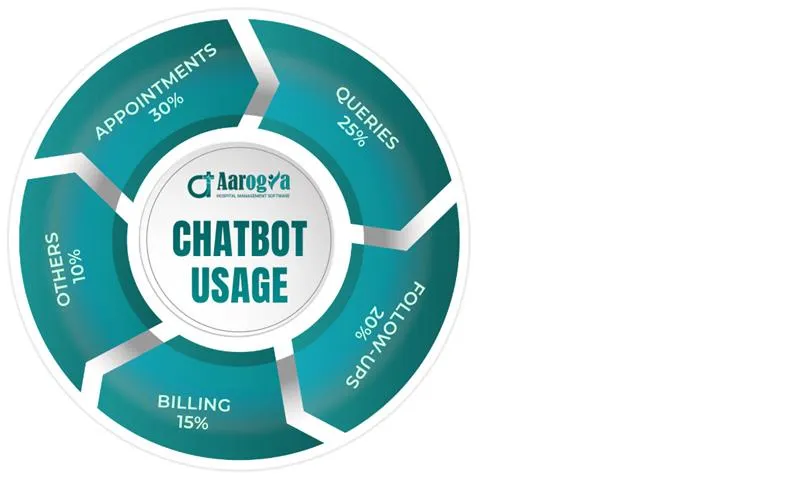
Chatbots can let patients arrange appointments without having to wait. They can recommend doctors based on their availability and specialization.
During hospital visits, chatbots help patients by providing directions, department information, and wait time updates.
Following the session, chatbots continue to interact by delivering reminders, follow-ups, and health advice.
Some important uses include:
- Schedule appointments.
- Responding to patient inquiries
- Billing and payment support
- Post-treatment follow-ups
- feedback collection
These application examples demonstrate how a healthcare chatbot can function as a continuous support system.

Transformation of the patient experience.
One of the most significant advantages of a healthcare chatbot is how it improves the patient experience.
Patients no longer have to rely only with healthcare personnel for basic information. A chatbot delivers immediate responses at any time of day.
This is consistent with global digital healthcare trends, which are explained here:WHO
A healthcare chatbot improves the user experience by:
- Providing immediate replies
- Reducing the frustration
- Provides tailored communication
- Maintaining continual involvement
A chatbot, for example, can use prior visits to remind a patient about medications or upcoming appointments. This level of personalization develops trust and increases treatment outcomes.
Operational Efficiency and Cost Advantages
Administrative duties consume a large portion of hospital budgets. A healthcare chatbot helps to decrease these costs by automating repetitive tasks.
Instead of recruiting more employees, hospitals can use chatbots to manage routine communication.
The benefits include:
- Operating costs were reduced.
- Improved staff productivity
- faster response time
- Increased workflow efficiency

Integration with HMIS Systems
When a healthcare chatbot is linked with hospital management systems, it gains additional capabilities.
Platforms such as dmAarogya enable chatbot conversations to be seamlessly linked to patient information, billing, and scheduling systems.
For instance:
- Appointments scheduled with chatbot are updated in the system.
- Patient queries are linked to medical history.
- Answer billing questions in real-time.
This integration means that chatbot conversation is not isolated, but rather part of a larger ecosystem.
To understand these systems, refer to: Health Informatics
AI and Future of Healthcare Chatbots
Advances in artificial intelligence and machine learning will shape the future of healthcare chatbot systems.
As explained in this article: Machine learning Chatbots will improve its intelligence over time as a result of encounters.
Future capabilities include:
- Preliminary diagnosis assistance
- Mental Health Assistance
- Telemedicine Integration
- Remote patient monitoring.
Industry thoughts into future trends can be found here Forbes
Government Support and Digital Health.
Government programs encourage people to use digital healthcare.
In India, organizations like the Ayushman Bharat Digital Mission attempt to establish a linked healthcare environment.
Visit ABDM and MOHFW for further information on related initiatives.
These efforts promote the use of healthcare chatbots in hospitals.
Implementation strategy
A healthcare chatbot requires careful planning and implementation.
Hospitals should begin with fundamental use cases like appointment scheduling and patient inquiries.
Steps include the following:
- Identify use cases:
- Select the correct platform.
- integrate with HMIS.
- Use real data to train a chatbot.
- Maintain performance.
Dashboards can also be used by hospitals to monitor chatbot performance based on parameters such as engagement and response time.

Also Read
For deeper understanding, explore:
- Natural language processing
- Chatbots in Health Care: Connecting Patients to Information
- Chatbots in Healthcare – A Study
- Healthcare Chatbot
These resources explain how AI and digital tools are shaping healthcare systems.
Conclusion
The rise of healthcare chatbots is changing how hospitals function and communicate with patients. Chatbot applications in hospitals are fast developing, ranging from appointment booking to post-treatment care.
Chatbot systems can help hospitals increase productivity, cut expenses, and improve patient satisfaction. Aarogya HMIS, for example, facilitates this transformation by integrating chatbot capabilities into hospital workflows. Hospitals may assure continuous, real-time communication with conversational systems such as Botlab Chat.
Adopting a healthcare chatbot is no longer an option; it is becoming a need for providing modern, patient-centered care.
Categories
Recent Posts
-
 28 Sep 2026What is NABH? Full Form, Accreditation, Certification & NABH-Certified HMS Explained
 -
08 Sep 2026EMR Software: What It Is, How It Works, Key Benefits, Features, and the Future of Digital Healthcare
-
16 Aug 2026What Is a Kiosk Machine? Smart Kiosks in Healthcare | Aarogya
-
27 Jul 2026Patient Drug Registry, Unified Health Interface (UHI) & NHCX FHIR: How Aarogya HMIS Can Power India's Next Generation Digital Healthcare
-
29 Jun 2026Best HMIS Software in Kolkata 2026: How Digital Healthcare Is Transforming Patient Care Across the City